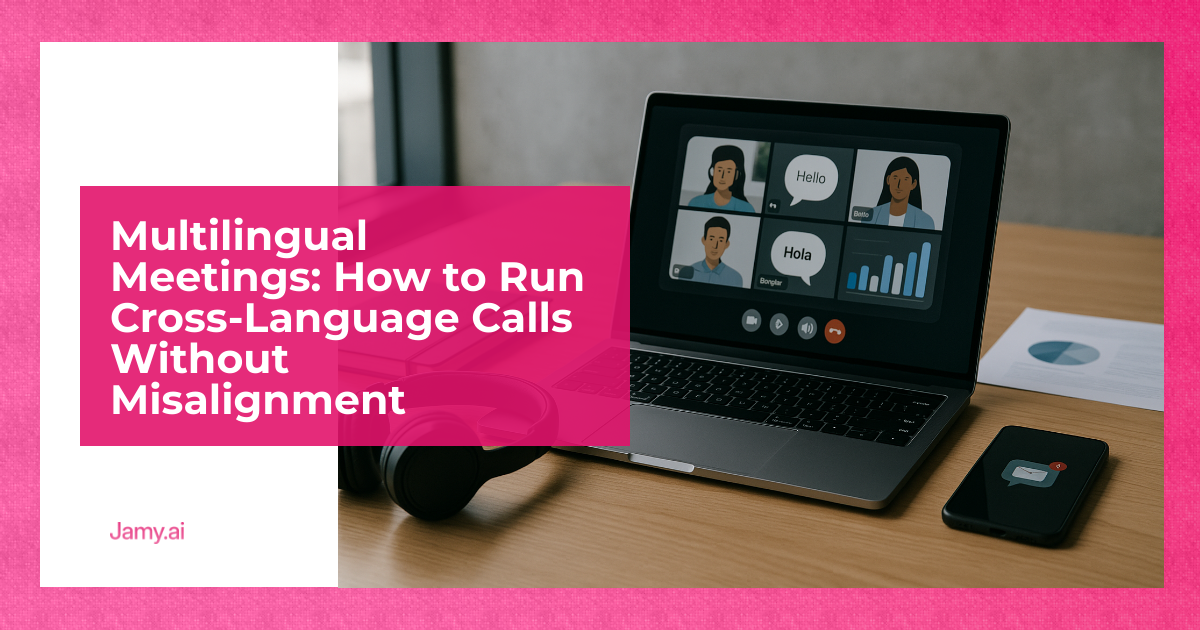

Multilingual meetings fail in predictable ways. The words get translated, but the decision doesn’t. People nod because they’re polite, not because they’re clear. Then the follow-up thread turns into a slow-motion argument about what was actually agreed.
You can fix most of this with a tighter operating model: clearer inputs, controlled turn-taking, and a written record that survives time zones and language differences. The aim isn’t perfect translation, it’s shared understanding, accountable owners, and fewer expensive reruns.
Below is a practical playbook you can run next week.
In this article, we’re going to discuss how to:
- Set up multilingual meetings so everyone can contribute without slowing the call to a crawl.
- Choose between interpretation, captions, and translation workflows based on risk and cost.
- Capture decisions and action items in writing so follow-ups don’t drift across languages and time zones.
Why Multilingual Meetings Go Wrong (And What It Costs You)
Cross-language calls add friction in four common places. None of them are solved by ‘speaking slowly’.
1) Unequal participation. Native speakers dominate, non-native speakers hold back, and the group confuses silence with agreement. You get a decision that’s socially convenient, not operationally sound.
2) Hidden definitions. Teams use the same term to mean different things: ‘launch’, ‘trial’, ‘qualified lead’, ‘handover’. Translation can be correct yet still wrong for your context.
3) Turn-taking breaks down. People interrupt, interpreters fall behind, and captions lag. The discussion becomes a series of half-finished thoughts.
4) The record is unusable. Notes are informal, partial, or written in a single language that some stakeholders can’t comfortably review. The result is rework, duplicate meetings, and missed deadlines.
Multilingual Meetings: A Simple Operating Model
Think of this as a light SOP. You’re not trying to create bureaucracy, you’re trying to remove ambiguity.
Before The Call: Reduce Translation Load
Most language problems start before the meeting. Fix the inputs and the meeting gets shorter.
- Write a one-page pre-read with: goal, context, decision needed, options, constraints, and the proposed decision owner. Keep sentences short and avoid idioms.
- Create a shared glossary for 10 to 20 terms that matter (product names, stages, commercial terms). Define them in plain English and add equivalents in other working languages where possible.
- Send questions in advance and invite written replies. Non-native speakers often produce higher-quality thinking in writing than in live debate.
- Decide the language of record (the language your decisions and action items will be written in). This prevents post-call debates about which version is ‘official’.
If you already use an assistant workflow, an AI meeting notes workflow can help standardise the pre-read structure and ensure the same fields get filled every time.
During The Call: Control The Rhythm
Multilingual meetings need tighter facilitation. You’re optimising for clarity, not spontaneity.
- Open with the goal and decision. Say what ‘done’ looks like. Repeat it once in simpler language.
- Use a ‘one point, then pause’ rule. One idea per person, then a short pause for interpretation or captions to catch up.
- Summarise in the language of record every 10 minutes. Ask for corrections: ‘Is that accurate?’ not ‘Does everyone agree?’
- Confirm owners and dates out loud. Names and deadlines are where translation errors become operational failures.
When discussions get technical, switch to a quick visual: a single slide, a list of options, or a table. Reading is often easier than listening in a second language.
After The Call: Publish A Decision Log, Not A Transcript
Transcripts are noisy. Operators need a decision record that can be audited later.
Use this post-call template:
- Decisions (with date): 1 to 5 bullet points, written in the language of record.
- Action items: owner, task, due date, dependencies.
- Open questions: who will answer, by when.
- Risks: what could break, early warning signal, mitigation owner.
For distributed teams, publish it within 2 hours while context is fresh. If it takes longer, it won’t happen.
Interpretation Vs Captions Vs Translation: What To Use When
There’s no single ‘best’ setup. Pick based on meeting type and the cost of misunderstanding.
As a rule of thumb:
- High-stakes decisions (commercial terms, hiring decisions, scope sign-off): use human interpretation or bilingual facilitation, plus a written decision log.
- Medium-stakes work (project updates, discovery calls): use live captions and a structured summary with actions.
- Low-stakes syncs (weekly team catch-ups): captions and disciplined facilitation is usually enough.
| Option | What You Get | Best For | Pricing (Typical) |
|---|---|---|---|
| Built-in platform captions | Live captions, sometimes translated captions, depends on plan and language support | Internal updates, discovery calls, reducing ‘I missed that’ moments | Included in certain paid plans, plan-based pricing |
| Platform language interpretation | Separate audio channels for interpreters and listeners | Large meetings, webinars, formal updates with Q&A | Higher-tier plan features, plus interpreter cost |
| Human interpreter (standalone) | Real-time interpretation and the ability to handle ambiguity and domain terms | Negotiations, legal or contractual discussions, exec-level decisions | Hourly or per-session fees |
| Structured meeting capture | Consistent summaries, action items, and decision logs for review across languages | Any meeting where follow-through matters more than perfect wording | Tool subscription, usually per user or per organisation |
For platform-specific capabilities, check the current documentation for your stack: Zoom interpretation features (Zoom Support), Microsoft Teams live captions and translation (Microsoft Support), and Google Meet translated captions (Google Meet Help).
Documentation That Stops Rework Across Languages
The meeting isn’t done when the call ends. In multilingual meetings, the written artefact is the product.
Here’s what a useful record includes:
- One sentence goal at the top, so late readers know why the meeting happened.
- Decision statements written as ‘We will…’ or ‘We will not…’ to remove ambiguity.
- Named owners for every action. ‘The team’ is not an owner.
- Dates in an unambiguous format (for example 27 Jan 2026).
- Definitions for any term that caused confusion, added to your glossary after the call.
If you’re trying to reduce documentation debt, using automated action items tied to a consistent template can keep the output predictable, while still keeping a human review step before anything is sent to clients or committed in the CRM.
Consent, Recording, And Data Handling (Information Only)
Recording and transcribing multilingual meetings can raise consent and privacy questions. Rules vary by country, sector, and the relationship between participants, so treat this as information only and get proper advice for your situation.
Operationally, keep it simple:
- Tell people you’re recording and why, at the start of the call, then capture that in the notes.
- Limit access to recordings and transcripts, and set retention periods that match your real needs.
- Don’t record by default for sensitive conversations unless you have a clear policy and a reason.
For general guidance, see the UK ICO’s overview on recordings and data protection (ICO UK GDPR guidance) and the GDPR text itself (EU GDPR).
Conclusion
Multilingual meetings work when you treat them as an operational process, not a language problem. Make the inputs clearer, slow the rhythm slightly, and publish a decision log that people can trust. Do that consistently and you’ll spend less time re-running calls and cleaning up misunderstandings.
Key Takeaways
- Fix the inputs first: pre-reads, a glossary, and a language of record cut confusion fast.
- Match the translation method to the risk: captions for speed, human interpretation for high-stakes calls.
- Ship a decision log with owners and dates within 2 hours, because that’s what drives follow-through.
FAQs For Multilingual Meetings
What’s the simplest way to improve multilingual meetings without buying new tools?
Send a one-page pre-read and enforce a written decision log with owners and dates. Those two steps prevent most of the ‘I thought you meant…’ rework.
Are live captions reliable enough for client calls?
They’re often good for comprehension, but they can still miss domain terms and names. For anything contractual or sensitive, treat captions as support, not the source of truth.
How do you stop stronger speakers from dominating the conversation?
Use structured turn-taking: one point per person, then a pause, and regular summaries that invite corrections. Also collect questions in writing before the call so quieter voices enter the agenda.
What should the official meeting output be when the team uses multiple languages?
Pick one language of record and write decisions and action items in that language every time. If needed, add a short translated summary for stakeholders, but keep one definitive version to avoid conflicting edits.
Try Jamy For Consistent Meeting Outputs
If you want a repeatable workflow for notes and follow-ups, Jamy is designed to produce structured summaries you can review and share.