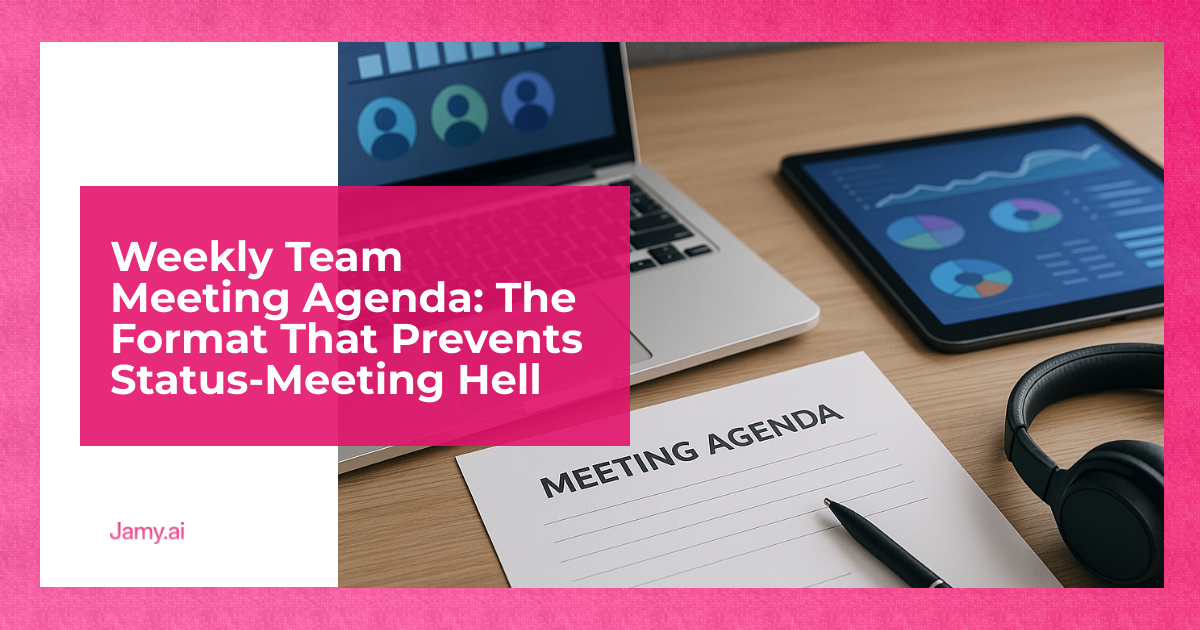

A weekly team meeting agenda should make decisions, remove blocks and keep work moving. In practice, many teams end up reading out updates that everyone already posted somewhere else. The cost is real: time, attention and a slow creep in accountability. The fix is not ‘better meetings’, it’s a tighter format with clear inputs and outputs.
Use the agenda below to turn your weekly slot into a decision-and-commitment meeting, not a live newsletter.
In this article, we’re going to discuss how to:
- Set up a weekly agenda that forces decisions and owners.
- Run the meeting so blockers get handled without derailing the room.
- Close the loop with follow-ups that don’t rely on memory.
Why Most Weekly Meetings Rot Into Status
Status-meeting hell usually comes from three avoidable problems.
- No shared pre-read: people use the meeting to broadcast, because they don’t trust the tools or the habits outside the call.
- No decision mechanism: the group discusses, but nobody is named as the decider, so topics drift.
- No closure: actions aren’t captured with an owner and a date, so the same issues return next week.
If you only fix one thing, fix closure. A meeting without owners and deadlines is just talk.
The Weekly Team Meeting Agenda That Actually Works
This format assumes a 45-minute meeting for a team of 5 to 12. If you’re bigger, split by function or run a tighter leadership version and let smaller squads run their own.
Before The Meeting: 10 Minutes Of Async Input
Send the agenda doc or ticket list 24 hours before. Ask for written updates, not spoken ones. The rule: if it’s not written down beforehand, it does not get read out in the meeting.
Async inputs to collect:
- Last week’s actions: done, blocked, or dropped (and why)
- Metrics that changed (only exceptions, not every number)
- Topics needing a decision this week, each with a proposed option
During The Meeting: A Script You Can Reuse
0 to 5 mins: Start on time, set the rules
- Confirm timebox and who is facilitating.
- Confirm who is taking notes.
- State the output: decisions plus actions with owners and dates.
5 to 15 mins: Review last week’s actions (only the exceptions)
Go line by line through the action list. If something is done, mark it and move on. If it’s blocked, you have two options: remove the block in the room, or assign it as a new action with a date.
Do not allow ‘still working on it’ without a next step and a date.
15 to 25 mins: Metrics and signals (exceptions only)
Pick 5 to 8 metrics that actually run the business. Review only what moved materially and what it means. If a metric is stable, you say ‘no change’ and move on.
This stops the meeting becoming a spreadsheet reading.
25 to 40 mins: Decision stack (top 2 to 3 items)
Bring decision topics in priority order. Each topic must have:
- A one-sentence problem statement
- A proposed option (even if it’s ‘do nothing’)
- A named decider (not always the most senior person, but someone accountable)
- A decision due in the meeting, or a clear next step to get to a decision
When discussion drifts, the facilitator asks: ‘What do we need to decide?’ Then either decide, or park it.
40 to 45 mins: Commitments and close
Read back actions, owners and dates. Confirm who sends the notes and when. End on time even if everything is not finished. That pressure forces better preparation next week.
Templates You Can Copy
Paste this into your doc tool and reuse it every week. Keep the headings identical so people learn the rhythm.
Weekly Team Meeting Agenda (45 mins)
- 1) Outcomes for today (2 mins)
- Decisions to make: [list]
- Risks to surface: [list]
- 2) Actions from last week (10 mins)
- [Action] Owner: [Name] Due: [Date] Status: Done / Blocked
- [Action] Owner: [Name] Due: [Date] Status: Done / Blocked
- 3) Metrics and signals (10 mins)
- Metric: [Name] This week: [X] Last week: [Y] Meaning: [one line]
- 4) Decision stack (15 mins)
- Topic: [one line]. Decider: [Name]. Proposed option: [A]. Decision: [Made / Deferred].
- 5) Parking lot (kept short) (5 mins)
- [Topic] Next step: [Owner + date]
- 6) Commitments read-back (3 mins)
- New actions: [list with owner + date]
- Next meeting: [date/time]
Making It Stick: Roles, Rules, And Guardrails
The agenda works when the team treats it like an operating rhythm, not a suggestion.
Set three roles:
- Facilitator: keeps time, keeps scope, forces decisions or next steps.
- Notes owner: captures decisions and actions in a standard format.
- Deciders: named per topic, so you don’t get ‘everyone agrees’ with no owner.
Use these rules:
- No round-the-room updates. Updates live in the pre-read.
- One conversation at a time. If debate splits, ask for a proposal and a decision.
- Everything that matters becomes a tracked item. If it is important, it gets an owner and a date.
Guardrails that keep you honest:
- If actions regularly slip, you are overcommitting. Reduce scope, or change priorities.
- If you never have decisions, your meeting is too safe. Add a decision stack every week.
- If you always run over, your topics are too big. Break them into smaller decisions.
Light Automation Without Losing Control
Most teams don’t fail because they lack effort. They fail because notes, actions and follow-ups live in too many places, and people leave the call with different interpretations.
A controlled approach is to automate the boring parts, then add a human review step. For example, you can use an AI meeting notes workflow to draft a summary, extract decisions and propose action items, then have the facilitator approve and publish the final version.
If you work across multiple languages, standard summaries help reduce meaning drift. A tool that produces multilingual meeting summaries can be useful, but keep a reviewer responsible for accuracy, especially for commitments and dates.
Recording and consent note: if you record meetings or process personal data, make sure you have a lawful basis and you inform participants. For UK organisations, start with the ICO’s UK GDPR guidance for organisations (source). This is information only, not legal advice.
Conclusion
A weekly meeting earns its slot when it turns uncertainty into decisions, and decisions into owned work with dates. Keep the pre-read strict, keep discussion tied to a decision, and treat the action list as the contract. After two to three weeks, you’ll feel the difference in fewer repeat conversations and cleaner follow-through.
Key Takeaways
- A weekly team meeting agenda should be built around decisions and tracked actions, not spoken updates.
- Use timeboxes and a ‘decision stack’ to stop the meeting being taken over by the loudest topic.
- Close every meeting with a read-back of owners and dates, then publish notes quickly while context is fresh.
FAQs for Weekly Team Meeting Agendas
What should a weekly team meeting cover?
Cover last week’s commitments, the small set of metrics that show health and the top decisions that unblock work. Leave general updates to an async pre-read so the meeting stays focused.
How long should a weekly team meeting be?
For most teams, 30 to 45 minutes is enough if updates are written beforehand. If you need longer every week, your agenda is doing project planning, not weekly operations.
How do you stop it becoming a reporting meeting?
Ban round-the-room updates and review only exceptions: what changed, what broke, what needs a choice. If a topic has no decision or next step, it goes in the parking lot with an owner and a date.
Should we use AI to write notes and action items?
It can save time if you keep a review step and publish a single approved version of the notes. If you adopt it, start with automated action items and a consistent summary format, then tighten your process over time.