
If you buy software or services for a living, you already know the failure mode: a ‘good call’, vague notes, then a messy internal thread about what was actually offered. The fix is not more meetings, it’s better capture. A vendor meeting agenda template sets the conversation up, but you also need a notes format that forces pricing, terms and next steps onto the page. This article gives you both, in a way your team can reuse without thinking.
Done well, your notes become a decision record: what was said, what was agreed, what is still unknown and who owns the follow-up.
In this article, we’re going to discuss how to:
- Prepare a vendor meeting agenda template that keeps sales talk on track
- Capture pricing, terms and risks in a repeatable call notes format
- Turn notes into accountable next steps with owners and deadlines
Why Vendor Calls Go Wrong On Paper
Most vendor calls fail in the handover. Someone attends, the conversation moves fast, and the write-up becomes a memory test. Days later you’re chasing basics: whether the price was list or discounted, what’s included, what’s excluded, and what ‘implementation support’ actually means.
Two practical causes show up again and again:
- Notes without a structure, so people capture opinions instead of commitments.
- No decision trail, so procurement, finance, security and the end user each interpret the call differently.
The goal is not to write more. It’s to record the few items that let you compare vendors fairly and avoid surprises later.
Vendor Meeting Agenda Template That Feeds Your Notes
This vendor meeting agenda template is designed to produce clean outputs: pricing, terms, risks and the next steps needed for an internal decision. Use it for first calls, renewals and competitive reviews.
60-Minute Vendor Meeting Agenda Template
- 0–5 mins: Context and outcomesShare your use case in one paragraph, then state what you need by the end of the call: a quote, a security pack, a pilot plan or a renewal proposal.
- 5–20 mins: Fit checkAsk for a plain description of how it works for your scenario, including what it does not do. Park feature touring unless it maps to your workflow.
- 20–35 mins: CommercialsPricing model, minimum term, payment terms, implementation costs, support tiers and any usage limits. Ask them to send the quote in writing.
- 35–50 mins: Delivery and riskImplementation plan, required internal effort, dependencies, data handling, SLAs and exit plan. If recording or data processing is involved, ask how consent and retention are handled.
- 50–60 mins: Decisions and next stepsAgree owners, deadlines and the exact artefacts to be sent. Confirm the date for the next touchpoint or the timeline for a ‘no’.
If your team needs the agenda and notes to stay consistent across calls, it helps to standardise the capture method too. An AI meeting notes workflow can draft the structure, but you still want a human to confirm the numbers and commitments before anything goes into the CRM or procurement folder. An AI meeting notes workflow can draft the structure, but you still want a human to confirm the numbers and commitments before anything goes into the CRM or procurement folder. For more on capturing and tracking, check Action Items From Meetings: A. Consider using 10 AI Tools to Sync for better efficiency.
Vendor Call Notes Template (Copy And Use)
Copy this into a doc, CRM note, or procurement system. It’s intentionally blunt. If a field is empty after the call, you know what to chase.
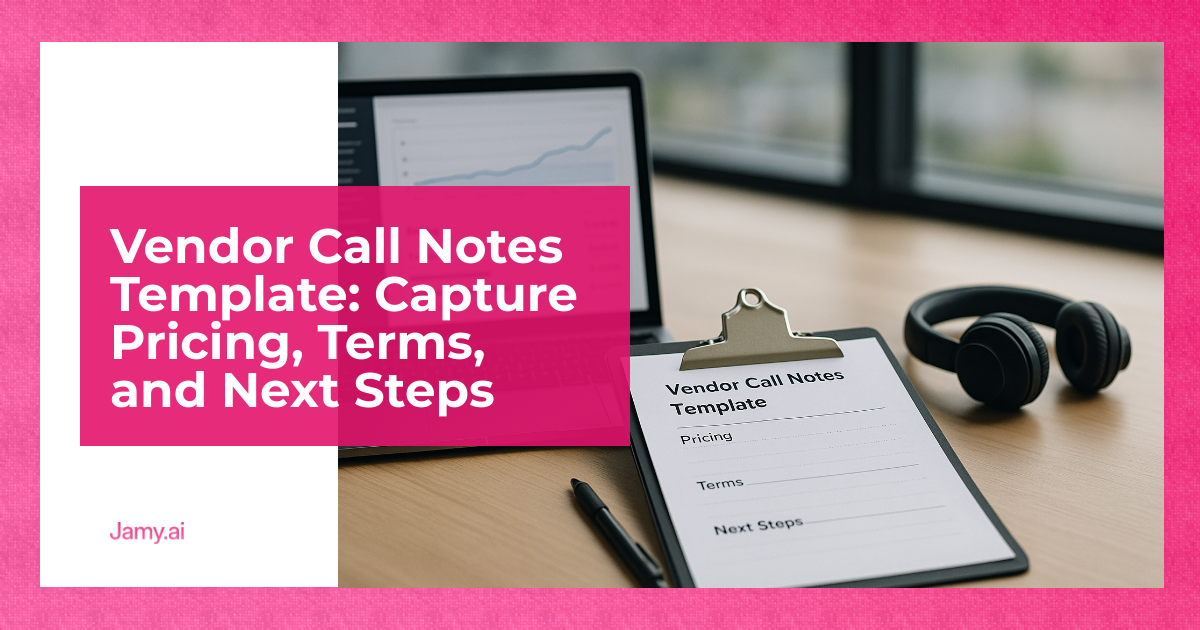
Vendor Call Notes Template
Call details
Date:
Attendees (your side):
Attendees (vendor):
Call type: First call / Renewal / Competitive / Implementation check-in
Recording: Yes / No (confirm consent policy)
Business context
Problem we’re solving (one sentence):
Success looks like (measurable):
Current workaround or incumbent tool:
What the vendor is offering
Product or service name:
What it does for our use case (plain English):
What it does not do or cannot commit to:
Pricing and commercials
Pricing model (per seat, per usage, flat fee):
Quoted price (currency, frequency):
Discounts or promotions (conditions, expiry):
Minimum term and renewal terms:
Payment terms (Net 30, upfront, etc):
Implementation or onboarding fees:
Support included, support upgrades and cost:
Price change policy or indexation:
Terms and legal checkpoints
Contract vehicle (MSA, order form, SOW):
Data processing terms available: Yes / No
Liability caps (if shared):
Termination and notice period:
Exit support and data export:
Security and compliance (high level)
Data types involved (PII, customer data, recordings):
Hosting region(s):
Access controls (SSO, SCIM, RBAC):
Certifications claimed (ask for evidence):
Incident response and breach notification summary:
Delivery and implementation
Implementation approach and timeline:
Vendor responsibilities:
Our responsibilities (people, time, systems):
Dependencies and blockers:
Risks, gaps, and open questions
1)
2)
3)
Next steps (must include owners and dates)
Vendor to send (quote, security pack, case studies): Owner, deadline
We will do (internal review, stakeholder sign-off): Owner, deadline
Next meeting booked: date/time or ‘awaiting artefacts’
Decision status
Stage: Exploring / Shortlist / Negotiating / Approved / Rejected
Decision date target:
Decision owner:
How To Run The Call So Notes Stay Accurate
A template is only useful if the call behaves. These behaviours keep the notes factual and usable.
Ask For Numbers Twice
When a price is spoken, repeat it back and capture the unit. ‘£12 per user per month, billed annually’ is different from ‘£12 a month’. Do the same for any usage limits, minimum seats and add-ons.
Convert Claims Into Commitments
‘We support that’ is not a commitment. Ask: ‘What exactly is included, what’s the dependency, and will you put that in writing in the order form or SOW?’
Tag Every Action With An Owner
‘Send us the security docs’ is a wish. ‘Vendor: Alex to send SOC 2 report by Thursday 5pm’ is a task. If you use automated summaries, make sure action items are reviewed before they are shared. A tool for automated action items can save time, but only if the owner and deadline are correct.
After The Call: Turn Notes Into Decisions
Good vendor notes reduce repeat conversations, but only if you use them to drive an internal decision loop.
24-Hour Follow-Up Pack
Within one working day, publish a short pack to stakeholders. Keep it boring and comparable:
- One-paragraph summary of the offer
- Pricing table (what you know, what’s missing)
- Risks and open questions
- Next steps with owners and dates
Decision Rules For SMEs
If you want fewer circular threads, set the rules upfront:
- Single decision owner for ‘go’ or ‘no go’
- Fixed inputs: quote, security answers, implementation plan, exit plan
- Timebox: if inputs aren’t delivered by a date, you pause or move on
This is also where a vendor meeting agenda template helps again. Reuse the same agenda for round two, but add a short ‘open questions only’ section so the vendor cannot restart the demo.
Compliance And Recording Basics (Information Only)
If you record vendor calls, treat it as a controlled process. Tell participants you’re recording, state the purpose, and confirm how the recording and transcript will be stored and for how long. In the UK, guidance from the Information Commissioner’s Office is a sensible starting point for thinking about transparency and lawful handling of personal data: ICO UK GDPR guidance.
This section is general information only, not legal advice. If you operate in multiple regions, check local consent rules and your internal policies.
Conclusion
A vendor meeting agenda template keeps the conversation disciplined, but it’s the notes that protect you later. Use a structure that forces pricing, terms, risks and next steps into the open. Then publish the decision trail quickly, while the call is still fresh.
Key Takeaways
- Use a vendor meeting agenda template that reserves time for commercials, risks and next steps
- Capture pricing, terms and delivery responsibilities in a fixed call notes format
- Ship a 24-hour follow-up pack with owners and deadlines, so decisions don’t drift
FAQs For Vendor Call Notes And Agendas
What’s the difference between a vendor meeting agenda template and call notes?
The agenda is the plan for the conversation, the notes are the decision record of what was said and agreed. You need both because a good agenda does not guarantee accurate capture.
How detailed should vendor pricing notes be?
Detailed enough that someone who missed the call can restate the total cost and the unit, including minimums, add-ons and billing frequency. If you cannot calculate year-one cost from the notes, they are not complete.
Who should own the vendor call notes in a small company?
Assign one named owner per call, typically the operator running the evaluation, not the most junior attendee. Everyone else can add comments, but one person should publish the final version.
Is it OK to record vendor calls for note-taking?
Often yes, but you should inform participants and follow your internal policy on storage and retention. If in doubt, review relevant guidance such as the Information Commissioner’s Office and get internal sign-off.
CTA: Make Vendor Call Notes Less Of A Chore
If you want this template to run itself, keep a human review step but automate the boring parts:
- Capture consistent meeting notes across vendor calls without relying on memory
- Create multilingual meeting summaries for global stakeholders who need the same facts
- Standardise automated action items so owners and deadlines don’t get lost