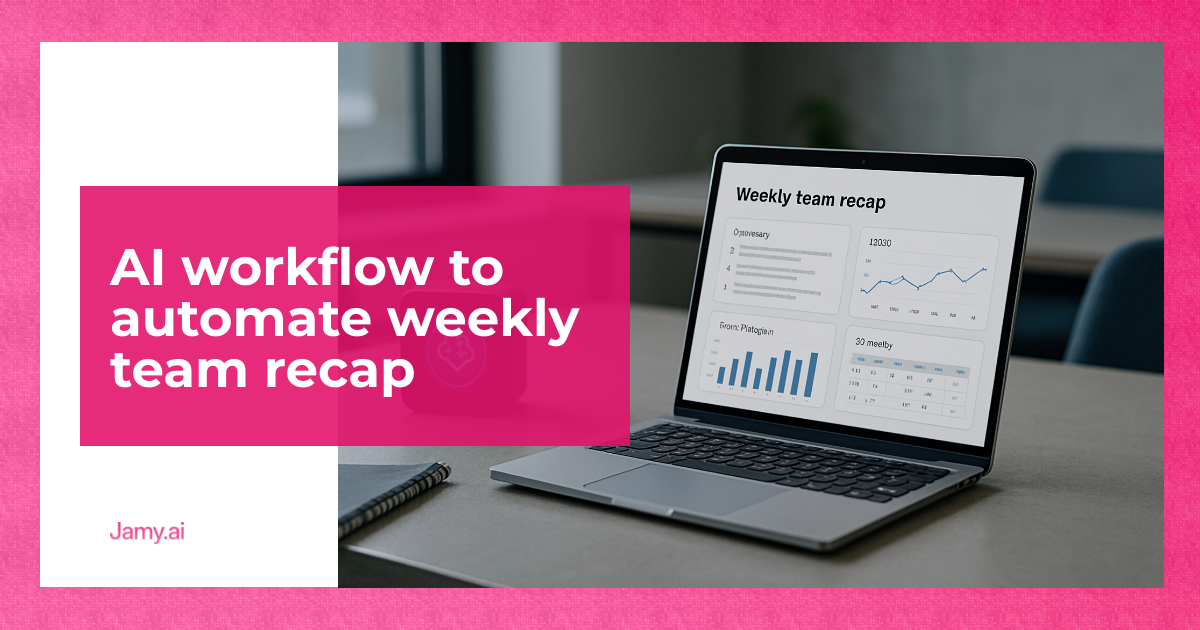

If your weekly team recap depends on someone’s memory, it’s already lying to you. Updates get missed, action items drift, and everyone spends Monday re-explaining last week, which is why you should Turn Every Zoom Call Into actionable items. An AI weekly team recap workflow can fix that, but only if you treat it like an operations system, not a novelty. This post gives you a repeatable setup with clear human review points, so the recap is consistent, auditable and useful.
In this article, we’re going to discuss how to:
- Design a reliable capture-to-recap workflow that produces the same outputs every week
- Use AI to draft summaries, risks and actions without losing accountability
- Ship recaps that drive decisions, not just ‘FYI’ noise
What An AI Weekly Team Recap Workflow Actually Is
An AI weekly team recap workflow is a repeatable process that turns your week’s meetings, calls and async updates into one standard recap. ‘Workflow’ matters here: you’re defining inputs, outputs, owners, checks and timing. AI is the drafting engine, but humans still own the final narrative and the commitments.
For most teams, the minimum viable recap includes:
- Outcomes: what changed, what shipped, what closed
- Decisions: what was decided and by whom
- Risks: what could block delivery or revenue
- Actions: what happens next, with an owner and deadline
Start With The Outputs: One Page, Same Format, Every Week
Before you touch any tooling, define a fixed recap format. If every recap looks different, people stop trusting it. Keep it short, predictable and written for someone who wasn’t on the calls.
Use this one-page template:
- Week ending: YYYY-MM-DD
- Top 5 outcomes: one line each, include numbers where possible
- Decisions made: decision, owner, date, ‘why’ in one sentence
- Risks and blockers: risk, impact, mitigation, owner
- Action list: action, owner, due date, status (new / in progress / done)
- Asks: what you need from leadership or other teams
Inputs You Need (And What To Ignore)
Most recaps fail because teams try to summarise everything. Don’t. Pick inputs that correlate with work and decisions.
Recommended inputs:
- Weekly team meeting recording and notes
- Customer calls that changed the plan (sales, onboarding, support escalations)
- Project status updates from your delivery tool (even a simple spreadsheet)
- Hiring pipeline changes (roles opened, interviews completed, offers out)
Usually ignore:
- Chat threads with no decisions
- Meetings that are pure ‘status theatre’
- Long transcripts without tags, outcomes or follow-ups
The SOP: Capture To Recap In 7 Steps
This is the operating rhythm you can run every week. The goal is that the recap takes 20 to 30 minutes of human time, not two hours of rewriting.
Step 1: Standardise Consent And Recording Rules
Decide which meetings get recorded and where recordings are stored. Tell attendees when you’re recording and why, and document your rule in the meeting invite. Keep this general and consistent across time zones.
Information only: recording and consent rules vary by country and context. If in doubt, get local guidance for your organisation.
Step 2: Capture Meetings With A Single Default
Make ‘record + transcript + summary’ the default for your recurring meetings, as outlined in Automating Recurring Meetings with AI. If you use Jamy, set up an AI meeting notes workflow so every weekly meeting produces the same artefacts: transcript, summary and action items, and consider how to automate meeting transcriptions with n8n.
Operational rule: if a meeting has no agenda, don’t record it, cancel it. Recaps can’t fix meetings that shouldn’t exist.
Step 3: Tag What Matters During The Call
Give the team three tags they can say out loud, so the transcript is easy to interpret:
- Decision: when a decision is made
- Action: when someone commits to work
- Risk: when a blocker is raised
This sounds basic, but it reduces the ‘AI guessed wrong’ problem because you’re feeding the model clearer structure.
Step 4: Use A Fixed Prompt For The Draft Recap
Whether you draft inside your tool or in your own system, use one stable prompt. Here’s a prompt you can paste into your recap job:
You are generating the weekly team recap. Use the standard format: Top outcomes (max 5), Decisions made (with owner and date), Risks and blockers (with owner and mitigation), Action list (action, owner, due date, status), Asks (if any). Be specific, remove filler, and do not invent numbers or dates. If an owner or due date is missing, mark it as ‘TBD’.
Rule: never allow ‘TBD’ to ship without an explicit follow-up action. ‘TBD’ is a polite way of saying ‘this will be forgotten’.
Step 5: Human Review In Two Passes
AI drafts fast, but humans protect accuracy. Review in two short passes:
- Pass 1 (owner check, 10 minutes): meeting owner scans decisions and actions, fixes owners and due dates
- Pass 2 (risk check, 10 minutes): team lead checks risks and asks, ensures the recap matches reality and current priorities
If you want this to stick, make the review a calendar event. Treat it like invoice approval: boring, necessary and time-boxed.
Step 6: Publish Recaps Where Work Happens
Pick one primary channel for recaps, and don’t spread them across email, chat and docs. In most SMEs that’s a shared doc or a dedicated channel. Post the one-page recap plus a short ‘what changed’ opener.
If you’re dealing with multilingual teams, generate a second version for clarity. Tools like Jamy can support multilingual meeting summaries so people can read in their strongest language without rewriting everything manually.
Step 7: Close The Loop With Action Item Hygiene
The recap is only useful if actions land in a system with owners and deadlines. At minimum, copy actions into your task tool. Better, automate the hand-off from notes to tasks, then audit it weekly.
Simple weekly audit checklist:
- Every action has one owner (not a team name)
- Every action has a due date (even if it’s ‘end of week’)
- Actions match decisions (no orphan tasks)
- Blocked actions are flagged with a next step
How To Measure If It’s Working (Without Vanity Metrics)
If you can’t tell whether the workflow helps, it will decay. Track a few practical indicators:
- Time to publish: recap sent within 24 hours of the last weekly meeting
- Action completion rate: % of actions closed by due date
- Repeat questions: how often people ask ‘what did we decide?’ in the following week
- Churn in priorities: how many ‘top priorities’ change week to week without a recorded decision
When metrics slip, the fix is usually one of two things: the team stopped tagging decisions, or no one is doing the review pass.
Common Failure Modes (And The Fixes)
Most teams don’t fail because the AI is bad. They fail because the workflow is loose.
- Problem: recap is too long. Fix: hard cap outcomes at five and actions at ten
- Problem: ‘TBD’ everywhere. Fix: add a ‘Fill missing owners and due dates’ task to the reviewer checklist
- Problem: actions aren’t followed. Fix: recap includes last week’s overdue actions at the top until they’re closed
- Problem: mistrust of summaries. Fix: include links to the source meeting artefacts internally, and require reviewers to correct errors
Conclusion
A weekly recap shouldn’t be a creative writing exercise, and it shouldn’t rely on one organised person. A well-run AI workflow makes the recap consistent, faster to produce and easier to audit, while keeping humans accountable for the truth. Start with a fixed format, then enforce capture, review and action hygiene.
Key Takeaways
- Define the recap outputs first, then build the AI workflow around them
- Tag decisions, actions and risks during meetings to improve summary quality
- Protect accuracy with short human review passes and strict action item ownership
FAQs For AI Weekly Team Recap Workflow
How long should a weekly team recap be?
One page is the right default, with a maximum of five outcomes and a clean action list. If it needs more space, your meetings are producing noise rather than decisions.
What’s the minimum setup to automate this with AI?
You need consistent meeting capture (recording and transcript), a fixed recap template and a named reviewer who publishes on schedule. Without those, automation just produces inconsistent text faster.
Can we use this workflow across sales, delivery and hiring?
Yes, but keep one shared structure and change only the input sources and a few labels. Cross-functional recaps work best when decisions and actions are written in the same format.
What about privacy, consent and compliance for recordings?
Set a written rule for when you record, how you inform attendees and where data is stored, and apply it consistently. This is general information only, and requirements vary by jurisdiction and context.
Try A Simple Setup In Jamy
If you want this workflow to run without extra admin, set up Jamy so the same meeting types produce the same artefacts every week. Keep humans in the loop for review and publishing, and let the system handle the drafting and extraction.
- Set up automated action items from meeting notes
- Build a repeatable weekly recap pipeline from your calls
- Support global teams with consistent summaries across languages