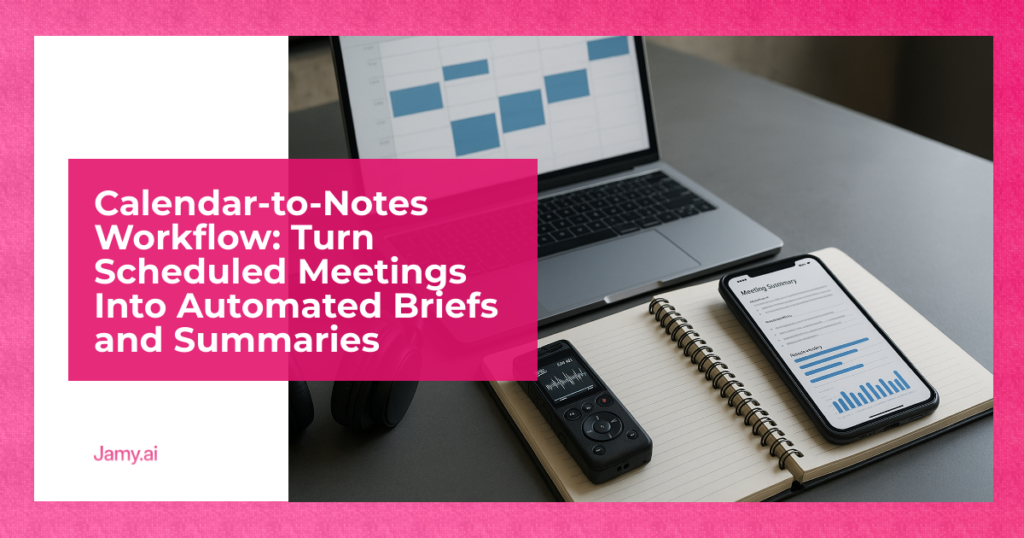

Most teams don’t have a note-taking problem, they have a consistency problem. Meetings get booked, people turn up half-prepared, and the follow-up depends on who was paying attention. That’s how decisions go missing, CRM fields rot, and action items slip without an owner. A calendar-to-notes workflow fixes the boring part by default, so your automated meeting notes are predictable, searchable and tied to the invite.
Done properly, it’s not ‘AI magic’. It’s a controlled system: clear inputs, a repeatable process, and human review points where it matters.
In this article, we’re going to discuss how to:
- Standardise meeting invites so the right context is captured before the call.
- Generate automated briefs and summaries that teams actually use, not just file away.
- Build a light governance layer for consent, storage and accountability.
What A Calendar-to-Notes Workflow Actually Is
A calendar-to-notes workflow treats the calendar event as the ‘source of truth’ for meeting metadata: who’s involved, what the meeting is for, and what systems should receive the output. The workflow then turns that metadata into two artefacts:
- A pre-meeting brief: agenda, context, links, goals and risks.
- A post-meeting summary: decisions, action items, open questions and next steps.
The point isn’t to produce more documents. It’s to reduce variance: every meeting gets the same minimum standard, without relying on heroics.
Automated Meeting Notes: Why Calendar Is The Right Trigger
Most teams try to fix notes after the call. The calendar approach fixes the inputs before the call, when it’s still easy to do. Calendar events also work across departments: sales calls, user interviews, hiring panels, project rituals and client check-ins all start as scheduled meetings.
If you standardise a few fields in the invite, you can route outputs automatically. For example, a ‘Customer Call’ type can send summaries to the account channel, create follow-ups for the owner and attach the notes to the right record in your CRM.
Google Calendar and Microsoft Outlook both expose event data via APIs, which is why calendar-triggered automation is common in modern tooling (see Google Calendar API documentation and Microsoft Graph event resource).
The SOP: From Invite To Brief To Summary
This is a practical SOP you can run with a small team in a week. Don’t aim for perfection. Aim for ‘works on 80% of meetings’ and then tighten it.
Step 1: Standardise The Calendar Event (5 Minutes Per Organiser)
Pick a small set of required fields and enforce them through habit, not bureaucracy. A simple rule: if it’s not in the invite, it doesn’t exist.
- Title: use a consistent format, for example ‘Company | Topic | Outcome’.
- Description: include agenda, context, links to docs, and ‘what good looks like’.
- Meeting type: add a prefix or tag, for example [Sales], [Discovery], [Hiring], [Delivery].
- Owner: name the person accountable for follow-up.
Step 2: Auto-Create A Pre-Meeting Brief (T-24h Or T-1h)
A brief is useful when it’s short and specific. Generate it from the invite and any linked docs, then post it where the team will see it.
Include:
- Attendees and roles
- Goal and non-goals
- Risks, for example ‘pricing discussion likely’ or ‘panel interview, keep scoring consistent’
- Questions to answer
- Links to the relevant record, doc or ticket
If you want this to run without babysitting, use a tool built for an AI meeting notes workflow that starts from the calendar invite and outputs a structured brief.
Step 3: Capture The Meeting Reliably
Decide what you’ll capture, and when you’ll record. Options include live note-taking, recording with transcription, or a hybrid where the system drafts and a human signs off. The key is consistency. If half your calls are captured and half aren’t, the workflow won’t earn trust.
For video calls, most platforms support recording and transcripts, but features and availability vary (see Zoom recording and transcripts and Microsoft Teams meeting recording).
Step 4: Produce A Summary That Matches How Operators Read
Long transcripts don’t help busy teams. Your post-meeting output should be skimmable and action-oriented. A solid default structure:
- Summary: 5 to 8 lines in plain English
- Decisions: what was agreed, and by whom
- Action items: owner, due date, acceptance criteria
- Open questions: what needs resolution, and the next touchpoint
Make the workflow strict about owners and deadlines. ‘Someone to follow up’ is how work disappears.
Step 5: Push Action Items Into The Systems People Already Use
Notes are only useful if they show up where the work happens. Route action items to your task system, and route customer-related items to your CRM. Even if you keep the process light, at minimum: create tasks with owners and dates, and attach the meeting summary to the relevant record.
Look for tooling that supports automated action items so your follow-up is created as part of the meeting, not as an optional extra afterwards.
Step 6: Store, Search And Review
Create one ‘home’ for meeting outputs, even if you forward summaries elsewhere. Define a weekly review habit for each team: 15 minutes to scan decisions and overdue actions. That’s where the time saving becomes real.
Templates You Can Copy
These templates are deliberately short. The goal is repeatability, not prose.
Calendar Description Template (Pre-Meeting)
Goal: What decision or outcome do we need by the end?
Context: 3 to 5 bullet points that explain why this meeting exists.
Agenda: Time-boxed topics (with owner for each topic).
Links: Doc, ticket, CRM record, prior notes.
Risks: What could go wrong, or what we must avoid.
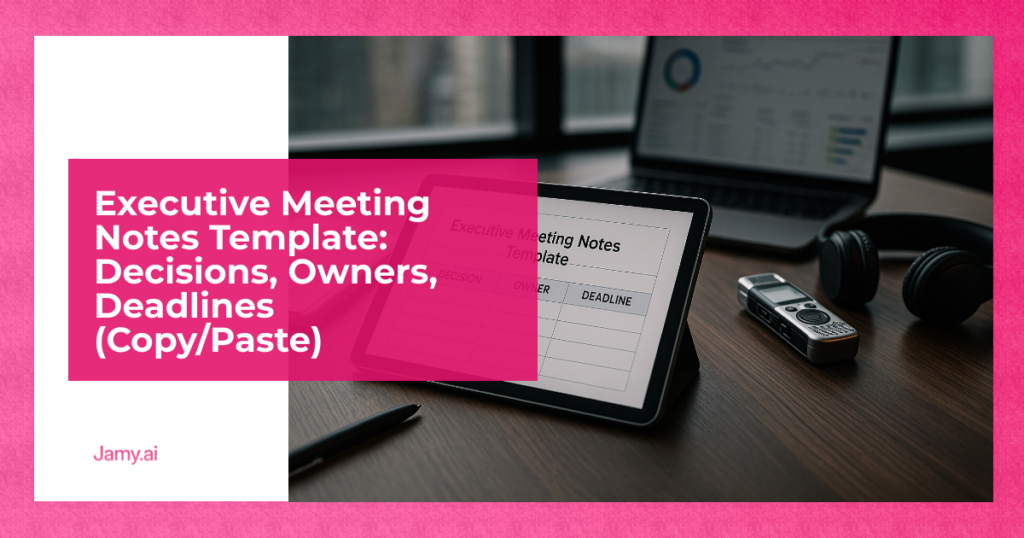
Post-Meeting Summary Template (After)
Summary: 5 to 8 lines.
Decisions: Decision, owner, date.
Action items: Action, owner, due date, definition of done.
Open questions: Question, who’s answering, by when.
Tooling Options And A Simple Comparison
You can run this workflow with basic tools, but you’ll pay in manual effort and inconsistency. Here’s a criteria-based comparison of three approaches.
| Approach | What You Get | Good For | Trade-offs | Typical Price |
|---|---|---|---|---|
| Manual notes only | Human-written notes, variable structure | Small teams, low meeting volume | Quality depends on the person, follow-ups slip | £0 cash cost, high time cost |
| Templates + human discipline | More consistent briefs and summaries | Teams who can enforce process | Still relies on people doing the work every time | £0 to low, plus staff time |
| Meeting assistant with calendar trigger | Automated brief, capture, structured summary, action routing | Teams with frequent calls and cross-functional stakeholders | Needs setup, review points, and permissions management | Subscription (varies by vendor and plan) |
Recording, Consent And Data Retention Basics
Be boring and consistent here. If you record or transcribe calls, make consent and retention part of the workflow, not a last-minute scramble. In the UK, personal data handling is governed by the UK GDPR and the Data Protection Act 2018, and the ICO provides practical guidance (see ICO UK GDPR guidance).
Information only: this section is general operational guidance, not legal advice. If you operate in multiple regions, get proper advice on your specific recording and data requirements.
Basic practices most operators can adopt:
- Tell attendees if the meeting is being recorded or transcribed, ideally in the invite and again at the start.
- Define a retention period, for example 90 or 180 days, unless there’s a clear reason to keep longer.
- Restrict access by default. Notes should be searchable by the right people, not everyone.
- Have a ‘do not record’ meeting type for sensitive topics (performance issues, certain negotiations).
Implementation Plan: 14 Days To A Stable Workflow
Rolling this out to the whole company on day one is how it fails. Start with one team and one meeting type.
- Days 1 to 3: choose the meeting types, define templates, agree naming rules, decide storage location.
- Days 4 to 7: set up calendar triggers, brief generation, summary structure, and action item routing.
- Days 8 to 10: run 10 to 15 real meetings, then review where the summaries were wrong or too vague.
- Days 11 to 14: tighten prompts or templates, add governance defaults, and document the process in one page.
Measure it like an operator: fewer ‘what did we decide?’ messages, faster follow-ups, better CRM hygiene, and fewer missed actions.
Conclusion
A calendar-to-notes workflow is simple: make the invite carry the context, then turn that context into a brief and a summary every time. The win isn’t the document, it’s the consistency and the follow-up discipline. Keep review points where mistakes are expensive, and automate the rest.
Key Takeaways
- Use the calendar invite as the trigger and the source of truth for meeting context.
- Structure outputs around decisions and action items with owners and deadlines.
- Roll it out to one team first, then standardise and scale once trust is earned.
FAQs For Calendar-to-Notes Workflows
Do I need to record every meeting to get automated meeting notes?
No, but your outputs will be thinner without a transcript. A common compromise is to record high-value calls (sales, discovery, interviews) and use brief templates for internal stand-ups.
How do we stop summaries becoming ‘nice to have’ documents nobody reads?
Make the summary the place where decisions and action items live, then review it weekly. If tasks and CRM updates come from the same output, people pay attention.
What should we do with recurring meetings like weekly delivery calls?
Keep the invite stable, but generate a fresh brief that pulls in last week’s open actions. Store each week’s summary with a consistent naming scheme so you can trace decisions over time.
Can this work for multilingual teams?
Yes, if you standardise the output language and keep terminology consistent. Use translation as a controlled step, and confirm any customer-facing wording with a human before sending.
Try Jamy Without Disrupting Your Current Workflow
If you want to operationalise this without building it all yourself, Jamy is designed to turn scheduled meetings into usable outputs with clear structure and review points. Explore the Jamy meeting notes tool, see how a calendar-to-summary workflow fits your team’s process, and check support for multilingual meeting summaries if you work across languages.