
If your hiring decisions depend on messy notes, you’re not really hiring, you’re guessing.
A solid interview notes template does two things: it forces consistency and it makes debriefs faster.
It also protects the candidate experience, because you stop improvising and start listening.
Most teams don’t need more interview stages, they need better evidence from the stages they already run.
This article gives you a workable template, not a theory lecture.
In this article, we’re going to discuss how to:
- Standardise interview notes without making conversations feel scripted.
- Score candidates using evidence, not vibes, so debriefs are shorter and fairer.
- Write bias-resistant summaries that make the final decision easier to audit.
Why An Interview Notes Template Beats ‘Good Memory’
Even experienced interviewers forget details, misremember timelines and over-weight the last 10 minutes of a call. That’s normal human behaviour, not incompetence.
A template fixes this by making everyone capture the same inputs. It also makes it obvious when someone’s notes are thin, or when a panel asked completely different questions.
Interview Notes Template: The One-Page Scorecard
Use one page per interview. If it doesn’t fit on one page, you’ll stop using it.
Scoring scale (keep it simple):
- 1 = No evidence / concerning evidence
- 2 = Some evidence, below bar
- 3 = Meets bar
- 4 = Strong evidence, above bar
- 5 = Exceptional evidence, rare
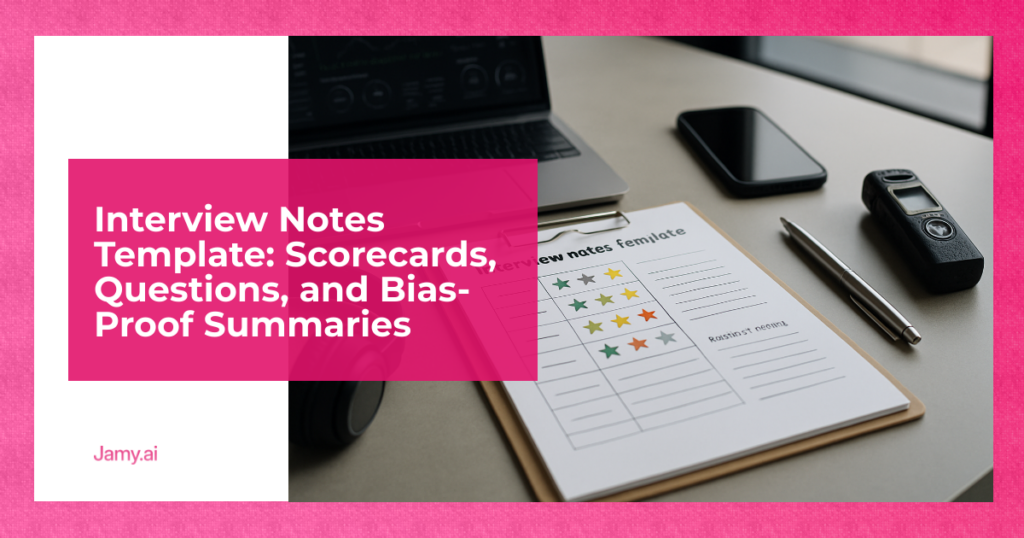
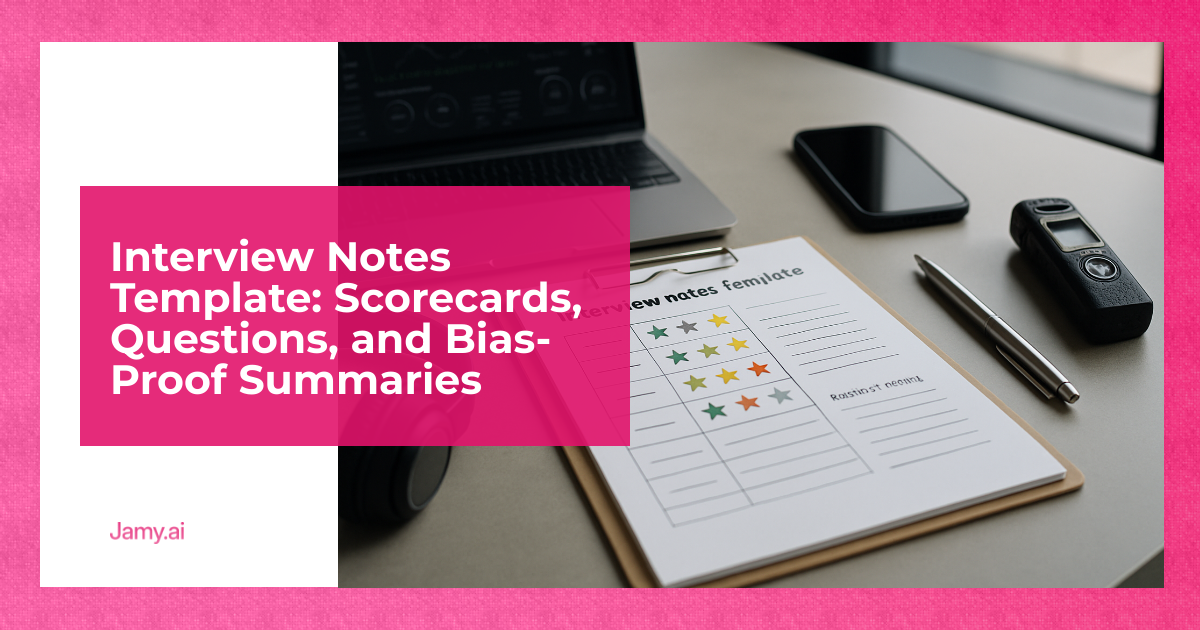
Interview Notes Template (copy/paste)
Candidate: [Name] Role: [Role] Date: [DD/MM/YYYY] Interviewer: [Name]
Interview type: [Screen / Hiring manager / Panel / Task review] Duration: [mins]
Competencies being assessed (tick the ones you owned):
- [ ] Role-specific skill 1
- [ ] Role-specific skill 2
- [ ] Communication
- [ ] Problem solving
- [ ] Stakeholder management
- [ ] Values/behaviours (define them)
Evidence log (write what you heard, keep it factual):
- Situation/Context: [What was the setting? team size? constraints?]
- Task: [What was their responsibility?]
- Actions: [What did they do, step by step? tools? decisions?]
- Results: [What changed? metrics? timeline?]
- Verification: [What would you check? references, portfolio, numbers]
Scorecard (add 1–2 lines of evidence per score):
- Competency A: [1–5] Evidence: [ ]
- Competency B: [1–5] Evidence: [ ]
- Competency C: [1–5] Evidence: [ ]
- Overall recommendation: [Strong yes / Yes / Hold / No / Strong no]
Risks and unknowns (be specific): [What might break? what’s unproven?]
Follow-ups needed (owner + deadline):
- [Owner] to [Action] by [Date]
- [Owner] to [Action] by [Date]
Operator note: don’t score ‘culture fit’. Score behaviours you can define and observe.
Question Bank: Consistent Prompts That Still Feel Human
Standardisation does not mean reading from a script. It means each candidate gets the same chance to show evidence for the same requirements.
Pick 6 to 8 core questions per interview type, then leave 10 minutes for follow-ups.
Core Questions (General)
- ‘Walk me through a project you owned end-to-end.’ Probe for scope, stakeholders, trade-offs and outcomes.
- ‘Tell me about a time something went wrong.’ Look for accountability, learning and prevention.
- ‘What do you do when you disagree with a decision?’ Test judgement and communication.
- ‘What does “great” look like in this role after 90 days?’ Checks role understanding and ownership.
Role-Specific Question Patterns
Instead of writing new questions for every role, use patterns:
- Decision quality: ‘What options did you consider and why did you pick that one?’
- Metrics: ‘Which number moved and what did you do to move it?’
- Systems thinking: ‘What process did you change so this didn’t depend on heroics?’
- Stakeholders: ‘Who blocked you, and how did you get it unblocked?’
If you’re running interviews over video calls, consider pairing your template with an AI meeting notes workflow so you can stay present in the conversation and still capture quotes accurately. Keep a human review step before anything goes into your ATS or decision doc.
Bias-Proof Summaries: Write What You Heard, Not What You Felt
‘Bias-proof’ is an ambition, not a guarantee. What you can do is reduce avoidable bias by separating observations from interpretations.
Use this two-part format in your summary:
- Observed evidence: direct quotes, specific actions, measurable results, concrete examples.
- Your assessment: what that evidence implies for the role, with a confidence level.
A Simple Summary Template
Summary (5–7 lines max)
Observed evidence: [2–4 bullets of facts, include one short quote if useful]
Assessment: [How this maps to the competencies and bar]
Confidence: [High / Medium / Low] because [what was tested, what wasn’t]
Recommendation: [Yes/No/Hold] with the single biggest reason
Compliance note (information only): if you record interviews, get clear consent and follow your local data protection rules. Also make sure your process avoids unlawful discrimination under applicable law, for example the UK Equality Act 2010:
Workflow: From Live Notes To A Decision In 24 Hours
Templates fail when the workflow is vague. Here’s a tight operating rhythm you can run with a small team.
1) Before The Interview (10 minutes)
- Paste the interview notes template into your doc or ATS form.
- Pre-fill competencies and the 6 to 8 core questions.
- Write down what ‘meets bar’ means for each competency in one line.
2) During The Interview (live)
- Capture short evidence snippets, not paragraphs.
- Mark ‘follow-up’ when something is unclear, don’t derail the flow.
- Don’t score until the last 2 minutes, scoring too early anchors you.
3) Immediately After (15 minutes)
- Fill gaps while your memory is fresh.
- Complete the scorecard with one line of evidence per score.
- Write the 5 to 7 line summary and set confidence level.
4) Debrief (30 minutes, same day)
- Each interviewer reads their summary first, no discussion yet.
- Compare scores competency-by-competency, ask ‘what evidence changed your mind?’
- Agree follow-ups with owners and deadlines, then close the decision.
If your team is distributed, using a consistent capture system plus automated action items can reduce the ‘what did we decide?’ back-and-forth. The point is not automation for its own sake, it’s fewer missed follow-ups.
Tooling Options Compared
You can run this process in a shared doc, inside an ATS or with a meeting notes tool that turns conversations into structured outputs. The right choice depends on volume, compliance needs and how often debriefs derail.
| Option | Best For | What You Get | Limitations | Price |
|---|---|---|---|---|
| Shared doc template | Early-stage teams, low volume | Fast setup, full control | Messy versioning, weak audit trail | Free |
| ATS scorecard forms | Teams already living in an ATS | Centralised records, permissions | Often clunky for real-time notes | Typically included in ATS plan (varies) |
| AI meeting notes tool + template | High volume, distributed panels, faster debriefs | Structured summaries, action tracking, easier retrieval | Needs consent process and human review | Subscription (varies) |
Conclusion
A good interview notes template is a small operational control that pays back quickly: better evidence, cleaner debriefs and fewer ‘gut feel’ decisions.
Keep it one page, keep questions consistent and force yourself to write factual summaries with a confidence level.
Once the template is working, tighten the workflow so decisions happen the same day and follow-ups have owners.
Key Takeaways
- Standardise notes and scoring so every candidate is assessed on the same evidence.
- Separate observations from interpretations to reduce bias and improve auditability.
- Pair the template with a clear 24-hour workflow so debriefs end in decisions and owned actions.
FAQs For Interview Notes Templates
What should an interview notes template include?
It should include the competencies being assessed, a short evidence log, a simple rating scale and a structured summary with risks and follow-ups. If it’s longer than one page, most interviewers won’t complete it properly.
How do you score interviews without over-complicating it?
Use a 1 to 5 scale with written anchors and require one line of evidence per score. The rule is simple: no evidence, no high score.
How do you reduce bias in interview notes?
Write observable facts first, then write your assessment separately with a confidence level. Avoid vague labels like ‘not a fit’ and instead name the competency and the missing evidence.
Can we record interviews to improve note quality?
Sometimes, but you need clear consent and a defined retention policy, and you should tell candidates how recordings are used. Treat this as information only and check your local rules and internal policies before recording.