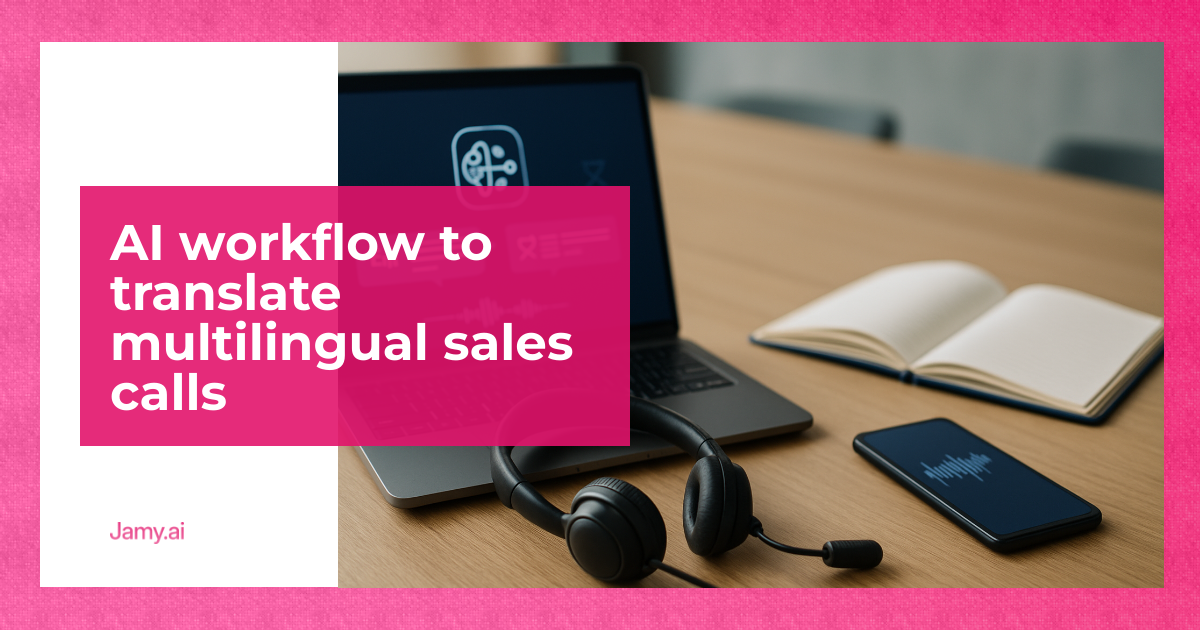

If you sell across borders, you already know the problem: the deal can be won or lost in the nuance. When teams try to translate sales calls after the fact, the output often arrives late, feels untrustworthy, or drops the commercial context that matters. The fix is not ‘more AI’ or ‘more process’, it’s a controlled workflow with clear owners and review points. Done properly, you can translate sales calls quickly enough to keep momentum, without turning your pipeline into a game of telephone.
Below is a practical workflow you can run with the tools you already have, plus a dedicated note and action system where it makes sense.
In this article, we’re going to discuss how to:
- Set up a repeatable workflow to translate multilingual sales calls with clear review steps
- Reduce mistranslation risk in pricing, legal terms and objections
- Turn translated notes into follow-ups, CRM updates and next steps that actually get done
Key Takeaways (Quick Scan)
- Start with the recording and transcript. Translation is only as good as the source audio and speaker attribution.
- Separate ‘verbatim’ from ‘commercial summary’. You need both, but they serve different jobs.
- Put a human in the loop on deal-critical sections. Terms, numbers, commitments and risks must be checked.
What ‘Translate Sales Calls’ Means In Practice
When operators say they need to ‘translate sales calls’, they usually mean four different outputs:
- A transcript: a written record of what was said, ideally with speaker labels and timestamps.
- A translation: the transcript converted into the team’s working language.
- A deal summary: what matters commercially, objections, risks, next steps, who owns what.
- Follow-up assets: an email draft, action list, and CRM fields updated while the call is still fresh.
Keep these separate. A translated transcript is not the same thing as an accurate commercial summary, and neither automatically creates accountable next steps.
How To Translate Sales Calls Without Slowing The Team Down
This is the workflow that tends to work for global teams: fast enough for pipeline speed, controlled enough for accuracy. You’ll see it used by sales, customer success, partnerships and also by product and hiring teams that depend on interview quality.
Step 1: Standardise Capture, Or You’ll Be Debugging Forever
Start by making call capture consistent. Pick a default video platform, require headset audio where possible and avoid two people sharing one mic in a noisy room. If your source audio is poor, translation quality drops and your team will stop trusting the output.
Decide, in writing, what happens when a call is off-platform (phone, WhatsApp, in-person). If you cannot record it, you still need a structured note template so you’re not guessing later.
Step 2: Get A Transcript First, Then Translate
Always produce a transcript in the original language before translating. Translating from raw audio increases errors and makes review harder.
Many meeting platforms provide live captions or transcripts, but the exact availability varies by licence and language support. Use official documentation to confirm what your stack can do, for example Microsoft Teams captions and transcription guidance (Microsoft Support).
Step 3: Produce Two Translations, ‘Verbatim’ And ‘Operator Summary’
Ask for two outputs:
- Verbatim translation: close to the transcript, preserving wording where it affects meaning.
- Operator summary: short, structured, and written for decision-making.
The summary should include what was agreed, what was not agreed, what is blocked and what happens next. If it reads like meeting minutes, it’s too long.
If you’re using an AI meeting system, make sure it can consistently generate structured notes and actions. A solid starting point is an AI meeting notes workflow that stores the transcript, summary and action items together so nothing gets lost between Slack, email and your CRM.
Step 4: Add A Human Review Gate Where It Matters
You do not need a bilingual reviewer for every sentence. You do need one for deal-critical content. Put a review gate on:
- Pricing, discounts, payment terms, contract length
- Security and data handling commitments
- Implementation timelines, dependencies and ‘who does what’
- Competitive references and switching constraints
Make the reviewer’s job small and specific. They should check the sections above, not rewrite the whole translation.
Step 5: Convert Translation Into Actions, Owners And Deadlines
This is where most teams lose time. They get a translated document, then still have to interpret it, write follow-ups, create tasks and update CRM fields. Instead, your workflow should output:
- Three to five action items, each with an owner and a due date
- A follow-up email draft in the customer’s language and your internal language
- CRM-ready fields (stage, next step, close date, risks, stakeholders)
If you want this to stick, make it the default ritual: translated summary and actions within two hours of the call, or it doesn’t count.
Step 6: Store Everything In One Place, With A Simple Naming Rule
Use a consistent naming convention so anyone can find the right artefact quickly:
- [Account] [Date] [Call type] [Language]
Keep the original transcript, the translated transcript, the summary and the action list together. Splitting these across tools increases rework and makes audits painful.
A ‘Call Translation Brief’ Template You Can Copy
Give this brief to whoever is producing the translation and summary (in-house, agency, bilingual teammate, AI system). It reduces ambiguity and improves consistency.
Call Translation Brief
Call type: Discovery / Demo / Pricing / Renewal / Incident / Interview
Original language(s): e.g. Spanish + English mixed
Target language for internal team: e.g. English
Customer-facing language for follow-up: e.g. Spanish
Must-keep terms: product names, legal terms, acronyms, competitor names
Deal-critical sections to verify: pricing, dates, obligations, risks
Output required: translated transcript + structured summary + action list + follow-up email draft
Deadline: within 2 hours / same business day
Quality Control: Prevent The Translation Errors That Cost Deals
Translation failures tend to cluster around the same areas: numbers, modality and politeness. Put a basic QC checklist in place and you’ll catch most issues early.
QC checklist (10 minutes per call):
- Numbers and units: prices, volumes, dates, time zones, VAT, currency
- Commitment language: ‘will’ vs ‘might’, ‘we can’ vs ‘we do’
- Negatives: double negatives and polite refusals
- Speaker attribution: who agreed to what
- Proper nouns: company names, people, products, countries
When something is ambiguous, capture it as a flagged question rather than guessing. The cheapest fix is a quick clarification message within 24 hours, not a re-run call two weeks later.
CRM And Follow-Up: Make Translation Pay Off
The goal is not a translated document. The goal is better decisions and fewer dropped balls. A practical flow looks like this:
- Immediately after the call: translation and operator summary produced
- Within 2 hours: follow-up email drafted and sent with clear next step
- Same day: CRM updated, tasks created, risks logged
If you’re trying to keep CRM hygiene under control, use a system that turns call outcomes into structured outputs. For example, multilingual meeting summaries can be paired with action items so follow-ups are not dependent on someone’s memory at 7pm.
Consent And Compliance Basics (Information Only)
If you’re recording and translating calls, treat it as a data handling process, not a personal productivity trick. In many jurisdictions you need a lawful basis and clear transparency about what you record and why. For general background, see the GDPR text on lawful bases (GDPR Article 6) and notice requirements (GDPR Articles 13 and 14), plus UK guidance from the ICO on call recording and privacy expectations (ICO).
Disclaimer: This section is information only, not legal advice. If you operate in regulated sectors or across multiple countries, get proper counsel and document your process.
A Simple Rollout Plan For A Global Team
Don’t roll this out everywhere at once. Start with a narrow slice of revenue activity, prove it saves time and improves accuracy, then expand.
Week 1: Pilot With One Region And One Call Type
Pick one high-frequency call type (discovery or renewal) and one language pair. Define what ‘good’ looks like: turnaround time, number of translation fixes per call, and whether action items are completed on time.
Week 2: Add A Review Queue And A Feedback Loop
Create a simple queue for flagged translation questions. Track the top recurring issues and update your ‘must-keep terms’ list and templates.
Week 3: Wire It Into Your Operating Rhythm
Make the workflow part of your regular rituals: pipeline review uses the translated operator summary, account handovers require the latest translated call pack, and post-mortems reference the transcript and decisions.
At this point, you can automate more of the work, but keep the human checks for the sections that carry commercial risk.
Conclusion
To translate sales calls reliably, you need a workflow that treats translation as a controlled operation: consistent capture, transcript first, two output types, and a review gate for deal-critical details. The payoff is not just comprehension across languages, it’s faster follow-up, cleaner CRM data and fewer avoidable misunderstandings.
Key Takeaways
- Translate sales calls from a transcript, not from raw audio, and store the original alongside the translation.
- Ask for both a verbatim translation and an operator summary, they solve different problems.
- Use human review for terms, numbers and commitments, then turn the output into owned actions with deadlines.
FAQs For Translating Multilingual Sales Calls
How fast should we aim to translate sales calls?
Aim for the same business day, and ideally within two hours for active deals so follow-up stays timely. If you cannot hit that, restrict translation to high-value calls and expand later.
Do we need bilingual reps to sell internationally?
Not always, but you do need a reliable way to review deal-critical language and avoid misunderstandings. A bilingual reviewer or interpreter can be used selectively for pricing, legal terms and complex objections.
What’s the difference between transcription and translation?
Transcription turns speech into text in the original language, translation converts that text into another language. For accuracy and auditability, do transcription first, then translate.
How do we stop mistranslations in pricing and contract terms?
Put those sections behind a mandatory review gate and require the reviewer to check numbers, dates, currencies and obligations. Keep a shared glossary of ‘must-keep terms’ and update it whenever an issue repeats.
Try Jamy.ai For Multilingual Call Translation Workflows
If you want a system that keeps transcripts, translations, summaries and actions together, take a look at Jamy.ai. You can use it to reduce documentation debt, improve follow-up speed and give distributed teams a single source of truth after every call.
- Set up automated action items from multilingual calls
- Create translation-ready call notes for sales and CS
- Standardise meeting summaries across time zones and languages