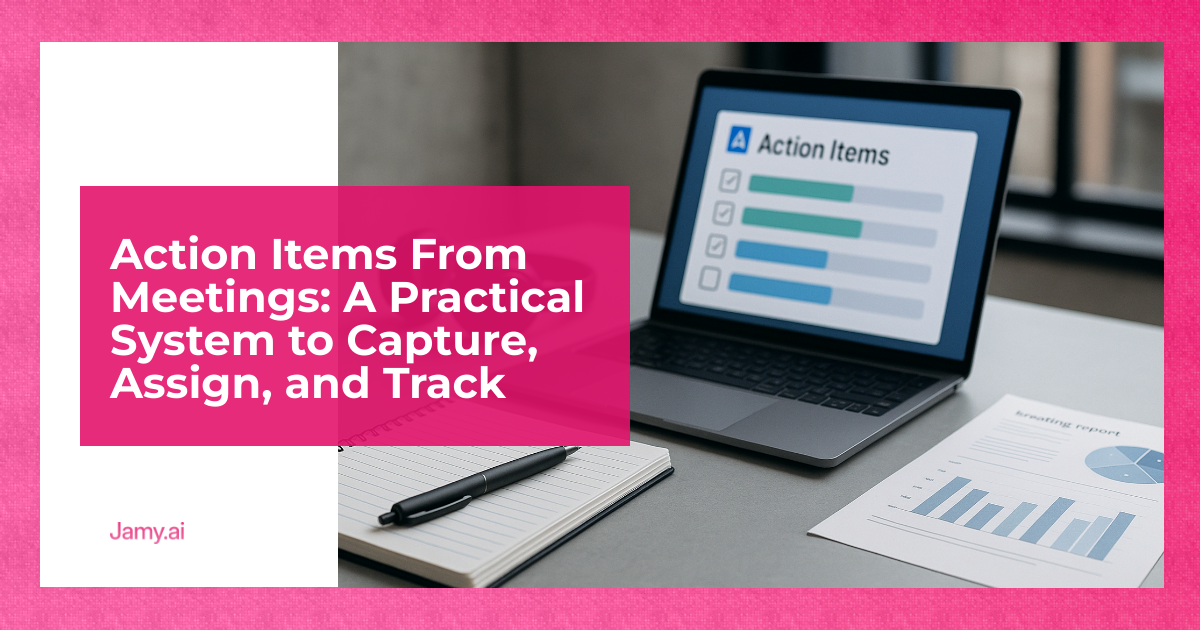

If your meetings feel busy but nothing moves, the problem usually isn’t effort, it’s ownership. Most teams are fine at talking through issues and terrible at turning talk into work someone actually does. That gap creates rework, missed handovers and the familiar ‘I thought you were doing it’. A solid system for meeting action items is less about tools and more about making accountability easy and unavoidable.
Get the basics right and you’ll spend fewer hours chasing updates, writing follow-ups and re-litigating old decisions. You’ll also get cleaner CRM and project data, because actions stop living in people’s heads and become trackable commitments.
In this article, we’re going to discuss how to:
- Capture action items without slowing the meeting down.
- Assign owners and deadlines in a way that survives handovers and busy weeks.
- Track follow-through using a lightweight rhythm that doesn’t create admin debt.
Key Takeaways
- One owner per action beats shared accountability every time.
- Deadlines need a date, not ‘ASAP’ or ‘next week’.
- Tracking needs a home, not a chat thread.
Why Meeting Action Items Fail In Real Companies
Failure patterns are boringly consistent, which is good news because they’re fixable.
- Actions are recorded as topics: ‘Pricing’ or ‘Onboarding’ is not an action. You need a verb and an output.
- Multiple owners: if three people ‘own’ it, nobody does. Pick one directly responsible person, others can be contributors.
- No deadline: actions with no date get pushed behind urgent work.
- No single source of truth: notes are in email, chat, docs and someone’s notebook. The team can’t rely on one place.
- No follow-up rhythm: if you don’t review actions, you’re hoping rather than managing.
Most teams try to fix this by writing longer notes. That just creates more reading, not more delivery.
A Practical System For Meeting Action Items
This is a simple operating system you can use across sales, delivery, product discovery, hiring panels and internal ops. It’s designed to work even when people miss meetings, teams are distributed and projects run across time zones.
The Four-Part Standard
Every action item should follow this format:
Verb + output (what will exist when it’s done)
Owner (one person)
Due date (a specific date)
Where tracked (the system it lives in)
Example: ‘Draft renewal email sequence v1 and share in the CS channel’, Owner: Sam, Due: 14 Feb, Tracked in: HubSpot task.
Step 1: Capture Meeting Action Items Without Slowing The Meeting
The capture step is where most process dies. If taking actions feels clunky, people stop doing it. The trick is to separate discussion notes from commitments.
Use A Dedicated Scribe Role (Rotate It)
Pick one person per meeting as ‘scribe’. They’re responsible for action capture only, not full minutes. Rotate the role weekly so it doesn’t become a punishment.
Rules for the scribe:
- Record actions as they are agreed, not at the end.
- Ask for clarity when an action is vague: ‘What’s the output?’
- Read back actions in the last two minutes.
Use Trigger Phrases To Force Clarity
Train the room to use simple phrases that make actions explicit:
- ‘Let’s turn that into an action.’
- ‘Who owns it?’
- ‘What’s the due date?’
It can feel formal for a week, then it becomes normal. Consistency matters more than elegance.
Step 2: Assign Owners And Deadlines That Stick
Ownership is not a name next to a bullet. It’s a commitment to drive the outcome, pull in contributors and report status. If you want action items to survive busy weeks, you need two things: a clear owner and an agreed deadline.
Owner Rules (Non-Negotiable)
- One directly responsible owner per action item.
- Owner must accept it in the meeting. If they’re not present, it’s provisional until they confirm.
- Contributors are optional: list them only if needed.
Deadline Rules (Avoid Fake Dates)
Use real dates and be honest about lead time. ‘Friday’ is fine. ‘End of week’ is often misunderstood across time zones. If the due date depends on someone else, capture both:
- Dependency: ‘Legal to review by 12 Feb’
- Outcome: ‘Send updated MSA to client by 14 Feb’
If you need a template line to keep it tight, use this:
Action: [Verb + output]. Owner: [Name]. Due: [Date]. Done when: [Acceptance test]. Tracked in: [System].
Step 3: Track In One Place (And Keep It Boring)
Pick a single system where actions live after the meeting. The best choice depends on the meeting type, but the rule is the same: if it isn’t in the system, it doesn’t exist.
Where To Track Different Types Of Actions
- Revenue meetings (pipeline, renewals, partnerships): CRM tasks and deal notes.
- Delivery and ops: your project tool (Asana, Jira, ClickUp, Trello) with assignees and due dates.
- Hiring: ATS tasks plus a scorecard or debrief record.
- Leadership meetings: a shared action register (simple spreadsheet works) if work spans multiple systems.
Keep the action register minimal. Recommended fields:
- Action (verb + output)
- Owner
- Due date
- Status (Not started, In progress, Blocked, Done)
- Link to artefact (doc, ticket, email draft)
Anything beyond that tends to become busywork.
Step 4: Close The Loop With A Weekly Follow-Through Rhythm
A system only works if actions are checked. You don’t need daily micromanagement. You do need a predictable cadence that forces updates and unblocks work.
The 15-Minute Action Review Agenda
Run this once a week for each team:
- Review overdue actions first, one by one.
- For each, ask: ‘Is it done, blocked, or deprioritised?’
- If blocked, capture a new action: ‘Remove blocker X’, with an owner and date.
- Close out completed items with a link to the output.
Two operator rules that keep this sane:
- No status speeches. One sentence per action item.
- Changes must be explicit. If the deadline moves or scope changes, record it.
Reducing Admin: Notes Automation With Human Checkpoints
If your team is on back-to-back calls, manual action capture is where things slip. A practical middle ground is automated meeting notes that extract action items, then a human quickly reviews and confirms before anything is assigned or sent out.
Two places this helps immediately:
- Sales and CS: consistent follow-ups, cleaner CRM tasks, fewer ‘what did we agree?’ emails.
- Product and discovery: action items tied to insights, so next steps don’t get lost after the call.
If you want to standardise this, build an AI meeting notes workflow that outputs actions in your four-part standard and routes them to the right system. For teams working across languages, using multilingual meeting summaries can reduce misunderstanding on commitments when stakeholders don’t share a first language.
Recording, Consent And Data Handling (Information Only)
If you’re recording meetings to create notes or action items, treat consent and privacy as part of the operating system. In the UK and EU, you generally need a lawful basis for processing personal data and you should be transparent about what you record, why you record it and how long you keep it. See the UK GDPR framework, including Article 6 lawful bases, for the underlying rules: GDPR Regulation (EU) 2016/679. For practical guidance, the ICO’s resources on call recording and privacy are a good starting point: Information Commissioner’s Office (ICO).
Disclaimer: this section is general information only and isn’t legal advice. If your organisation operates in regulated sectors or across multiple jurisdictions, get appropriate counsel and document your policy.
Conclusion
Meeting action items are only useful if they survive the meeting and turn into visible work. Keep the format strict, make ownership explicit, put everything in one tracking home and run a short weekly review to clear blockers. Once that’s working, automation can reduce the admin without removing human judgement.
Key Takeaways
- Use a four-part standard for meeting action items: verb plus output, one owner, a real due date, and a clear tracking home.
- Make follow-through predictable with a 15-minute weekly action review that prioritises overdue and blocked items.
- Use notes automation with human review to reduce admin while keeping accountability and data quality intact.
FAQs
What’s the difference between a decision and an action item?
A decision is what the team agreed is true or chosen. An action item is the work that must happen next, with an owner and due date.
How many action items should a meeting produce?
As a rule, fewer is better if they’re real commitments. If you’re leaving with more than 8 to 10 actions from a 60-minute meeting, you probably captured topics rather than outcomes.
What if the right owner isn’t in the meeting?
Record the action with a provisional owner and a short confirmation deadline. If they don’t accept, reassign immediately rather than letting it sit in limbo.
Should we send meeting minutes or just action items?
Send action items by default and add only the decisions and key context needed to execute. Full minutes are useful for regulated environments, but most teams don’t read them and they create extra admin.
Next Step: Make The System Easier To Run
If you want to reduce the manual work while keeping clear human checkpoints, Jamy can help you standardise capture and follow-through:
- Turn calls into clean action items using a consistent format your team can trust.
- Create automated action items that your scribe can review and confirm in minutes.
- Standardise meeting notes across teams so owners, deadlines and outputs don’t get lost.