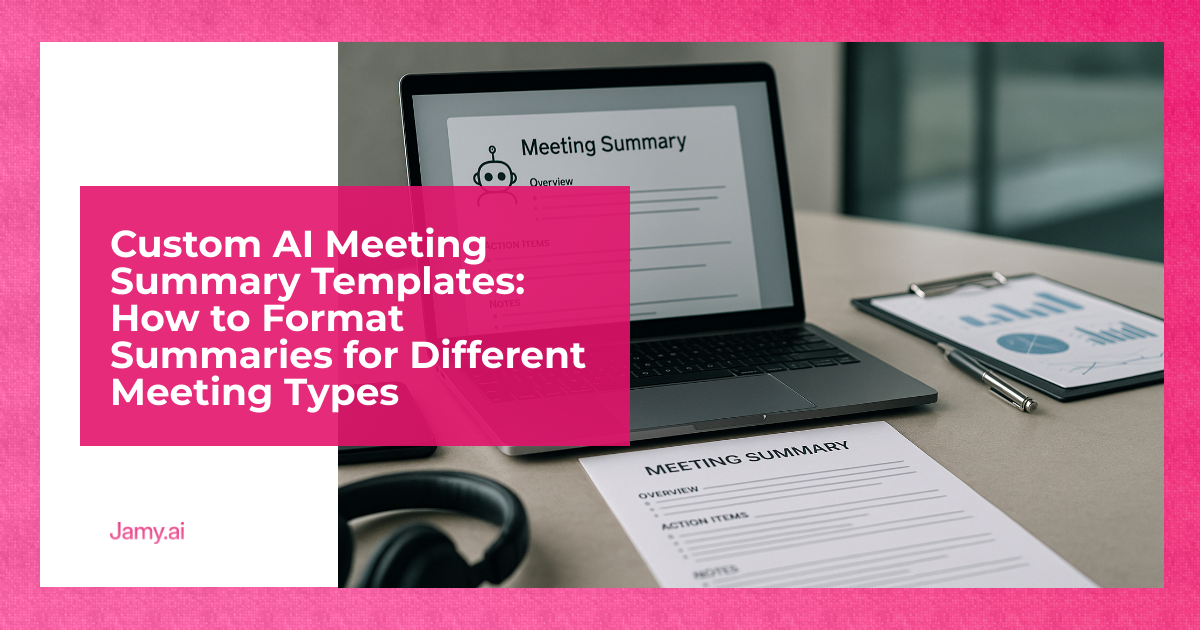

If your meeting summaries are inconsistent, people stop reading them. Then actions slip, decisions get revisited, and your CRM turns into a graveyard of half-truths. Custom AI meeting summary templates fix this, but only if you design them for the meeting you actually ran. This article gives you formats you can copy, plus a simple system for keeping the output accurate and accountable.
In this article, we’re going to discuss how to:
- Choose the right summary structure for the meeting type and audience.
- Standardise decisions, actions, and owners so nothing gets lost after the call.
- Run a lightweight review process so AI outputs stay trustworthy.
Why Most Meeting Summaries Fail In Practice
Operators don’t need ‘notes’. They need a record of what changed. Most summaries fail because they:
- Mix facts, opinions, and next steps into one blob.
- Omit owners and deadlines, so actions become suggestions.
- Ignore the meeting’s goal, so important details get the same weight as chatter.
The fix is simple: treat the summary as an operational artefact. That means consistent headings, a short decision log, and a place to capture risk and follow-ups. AI helps with speed, but the template is what makes it usable.
How To Build Custom AI Meeting Summary Templates That People Actually Use
When you design custom AI meeting summary templates, start with the outcome, not the transcript. Use this quick build method:
Step 1: Declare the meeting type and ‘primary output’. For example, sales discovery outputs a next step and a mutual plan. A hiring interview outputs an evidence-based scorecard and decision.
Step 2: Pick 5–7 headings max. If people have to scroll, they won’t read. Keep headings stable across the same meeting type.
Step 3: Force accountability. Every action should have an owner and due date. If those are unknown, explicitly mark them as ‘TBD’ rather than guessing.
Step 4: Separate ‘decisions’ from ‘discussion’. This stops re-litigating the call later.
Step 5: Add a review checkpoint. AI should draft, a human should verify anything that changes commitments, pricing, scope, or hiring outcomes.
If you want a repeatable workflow, use an AI meeting notes workflow that produces consistent sections and action items, then routes them to the right place.
Template Pack: Copy-Paste Formats For Common Meeting Types
Each template below is designed for fast scanning. You can paste these headings into your docs, CRM activity notes, or your internal wiki. If you’re using AI, include the meeting type at the top so the model knows which structure to follow.
1) Sales Discovery Call Summary Template
Sales Discovery Summary
Attendees: [Names, roles]
Context: [Why they took the call, current state]
Problems Stated (in their words): [Bullets]
Impact: [Time, money, risk, missed targets]
Current Process / Tools: [What they do today]
Decision Criteria: [What matters, must-haves]
Stakeholders: [Economic buyer, champions, blockers]
Timeline: [Target date, dependencies]
Next Steps (owner + date): [Action list]
Open Questions: [What you still need to qualify]
Operator tip: keep ‘Problems Stated’ verbatim where possible. It makes follow-ups and internal handovers far more accurate.
2) Project Kick-Off Summary Template
Project Kick-Off Summary
Goal: [What success looks like]
Scope In: [Included deliverables]
Scope Out: [Explicit exclusions]
Milestones: [Dates, dependencies]
Roles: [Owner, approver, contributors]
Risks & Assumptions: [Top 3–5]
Decisions Made: [Decision log]
Actions (owner + date): [Action list]
Comms Cadence: [Weekly update day, channel, format]
Operator tip: ‘Scope out’ is where delivery teams save their margins. Write it like a contract, not a hope.
3) Weekly Team Stand-Up Or Ops Sync Summary Template
Weekly Ops Sync Summary
Wins: [1–3 lines]
Metrics: [Inputs and outputs that matter]
Decisions: [What changed since last week]
Blockers: [Blocker, owner, ask]
Top Priorities (this week): [3–5 items]
Actions (owner + date): [Action list]
Operator tip: if it’s not in ‘Decisions’ or ‘Actions’, it didn’t happen. This keeps the meeting short and the follow-through visible.
4) Customer Support Escalation Summary Template
Support Escalation Summary
Customer: [Name, plan, account owner]
Issue: [What’s broken, when it started]
Severity: [Impact, workaround, affected users]
Repro Steps / Evidence: [Logs, screenshots, timestamps]
What We’ve Tried: [Actions taken]
Current Status: [In progress / mitigated / resolved]
Next Update To Customer: [Owner + time]
Internal Actions (owner + date): [Engineering/support tasks]
Operator tip: insist on timestamps. Without them, engineering loses hours.
5) Hiring Interview Summary Template (Structured)
Interview Summary
Role: [Role name] Candidate: [Name] Interviewer: [Name]
Competencies Assessed: [List the competency framework used]
Evidence (quote or specific example): [Bullets tied to competencies]
Concerns: [Specific, observable]
Scorecard: [Competency: score /5 + one-line rationale]
Recommendation: [Strong hire / hire / no hire / strong no hire]
Follow-Ups: [References, work sample, next interview focus]
Information only: if you record interviews or use automated transcription, check the rules that apply to your business, your location, and the platforms you use. Keep consent and retention policies clear for candidates.
6) Product Discovery Interview Summary Template
Product Discovery Summary
User Profile: [Role, company size, context]
Jobs To Be Done: [What they’re trying to achieve]
Current Workflow: [Steps and tools]
Pain Points: [What’s slow, risky, annoying]
Workarounds: [Spreadsheets, manual processes]
Signals Of Value: [What ‘better’ means to them]
Quotes: [3–5 short quotes]
Opportunities / Hypotheses: [What to test next]
Actions (owner + date): [Research, prototype, follow-up]
Operator tip: don’t let the summary sneak in solutioning. Keep it anchored in evidence and quotes.
Quality Control: A Simple Review Checklist For AI-Generated Summaries
AI drafts are fast. They’re also capable of confident nonsense. Use this 2-minute check before sending anything externally or logging it as ‘truth’:
- Names and companies: spelled correctly, right titles.
- Numbers: pricing, dates, targets, quantities verified.
- Commitments: actions match what was agreed, owners are real people.
- Decisions: only include decisions actually made, not implied.
- Sensitive content: remove anything not needed for the recipient.
For distributed teams and global calls, add one more check: does the wording survive translation without changing meaning? Tools that support multilingual meeting summaries can reduce misinterpretation, but you still need a human to sanity check key commitments.
Distribution: Where The Summary Should Live (So It Gets Used)
A good summary in the wrong place is dead. Pick the system based on who needs to act:
- Sales: CRM activity note plus a short follow-up email.
- Delivery: project workspace, with actions mirrored into the task tracker.
- Hiring: ATS notes plus a structured scorecard record.
- Leadership updates: a single weekly digest with decisions and risks only.
Whichever route you choose, make ‘actions (owner + date)’ non-negotiable. If you’re trying to cut admin overhead, an automated action items setup that feeds tasks and CRM updates can pay for itself purely in fewer dropped balls.
Conclusion
Meeting summaries become useful when they’re predictable, accountable, and designed for the meeting’s purpose. Start with one or two meeting types you run every week, then standardise the headings and review process. Once the team trusts the format, automation becomes safe rather than risky.
Key Takeaways
- Design each summary around the meeting’s primary output, not the transcript.
- Separate decisions from discussion, and force owners plus deadlines for every action.
- Use a short verification checklist so AI speed doesn’t create operational debt.
FAQs For Custom AI Meeting Summary Templates
How long should a meeting summary be?
One screen is a good target for internal summaries, with links to detail if needed. If it’s longer, trim discussion and keep decisions and actions intact.
Should I include full transcripts in the summary?
Usually no, because transcripts are hard to scan and rarely drive action. Keep transcripts as an attachment or reference, and put the operational record in the summary.
What’s the safest way to use AI for meeting summaries?
Use AI to draft, then require human review for anything involving commitments, pricing, scope, hiring decisions, or customer escalations. Save the final version in the system of record so it doesn’t get lost in chat.
Do I need consent to record meetings for AI notes?
Rules vary by location and context, so treat this as information only and check the guidance that applies to you. As a baseline, be transparent, get consent where required, and keep retention and access controls clear.
Make Templates Repeatable With Jamy.ai
If you want these formats to run without constant manual editing, set up Jamy.ai so your calls output consistent sections every time and route actions to the right system. Start with one meeting type, prove accuracy, then expand.
- Meeting notes and CRM updates that follow a defined structure
- Multilingual summaries for global teams to reduce misalignment
- Structured action lists with owners and due dates to keep follow-through visible