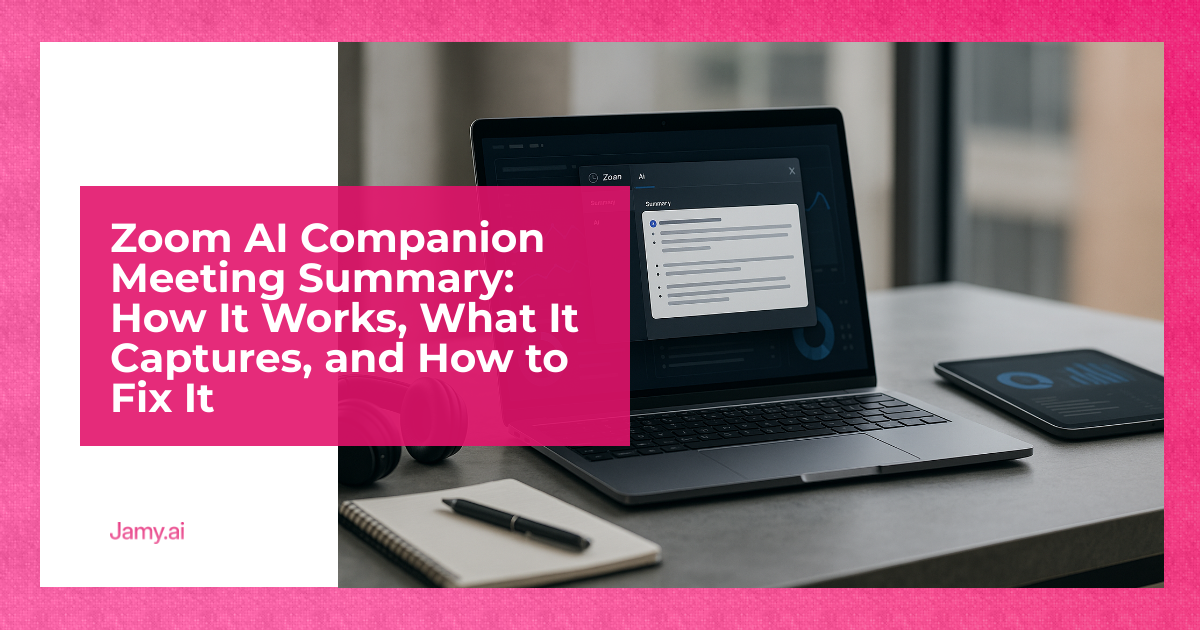

If you’ve tried a zoom ai meeting summary and thought, ‘That’s not what we agreed’, you’re not alone. Meeting summaries are only as good as the audio, the transcript and the way the call is run. Zoom AI Companion can save time, but it’s not a neutral, perfect scribe. Treat it like a junior note-taker: give it structure, check its work and make the follow-up unmissable.
Done well, you get faster recaps, clearer owners and fewer ‘what did we decide?’ messages. Done badly, you get vague bullets that create more work than they save.
In this article, we’re going to discuss how to:
- Set up Zoom so the summary is based on clean inputs, not guesswork.
- Spot what the summary will miss, then plug the gaps with a simple call workflow.
- Fix common failure modes and turn the output into actions you can track.
How Zoom AI Companion Meeting Summary Works (And Where It Breaks)
Zoom AI Companion Meeting Summary is a feature that generates a written recap of your call. In plain terms, it reads what Zoom thinks was said, then compresses it into themes, decisions and next steps.
That process usually depends on three inputs:
- Audio quality: background noise, cross-talk and weak mics reduce accuracy.
- Speaker clarity: accents, fast speech and people talking over each other can confuse the transcript.
- Structure of the conversation: a rambling call gives a rambling summary.
Where it breaks is predictable. If the call has poor audio, unclear agenda, multiple topics in parallel or lots of ‘this or that’ debate, the model tends to produce safe, generic lines. Those look tidy, but they’re not operationally useful.
Zoom AI Meeting Summary: What It Captures Vs What It Misses
For high-intent users, this is the key question: what does a zoom ai meeting summary reliably capture, and what does it tend to drop?
It tends to capture reasonably well:
- The main topics discussed, if people use consistent words for them.
- Clear, spoken decisions, especially if someone says, ‘Decision: we’re doing X’.
- Obvious action items when an owner and a deadline are said out loud.
It often misses or weakens:
- Edge cases and exceptions (the bits that save you from rework later).
- Numbers and constraints, especially when they’re mentioned quickly or compared verbally.
- Trade-offs and the ‘why’ behind a decision, which is what your team needs two weeks later.
- Names and ownership if multiple people share tasks or if people refer to ‘someone from your side’.
- Non-verbal agreement, for example nodding, silence or a quick ‘yep’ after a complex summary.
Practical takeaway: if you want accurate follow-through, you need to make ownership and dates explicit on the call, not ‘implied’. The AI can’t read your org chart or your intent.
A Fast Triage Checklist When Your Summary Is Wrong
When the summary looks off, don’t start by blaming the model. Do a quick triage so you know what to fix next time.
- Was the transcript correct? If the transcript is wrong, the summary will be wrong. Skim the section where the summary goes strange and see if the words are misheard.
- Did people talk over each other? Cross-talk causes merged sentences and missing owners.
- Did you switch topics mid-stream? The model may merge two threads into one vague point.
- Were decisions spoken as decisions? If no one states the outcome, you’ll get a ‘discussion summary’ instead of a decision log.
- Were next steps spoken with owners and dates? ‘Let’s do that next week’ is not enough. Say, ‘Sam to send the revised quote by Thursday 16:00’.
This is the same discipline you’d apply to a human note-taker. Clear inputs lead to usable outputs.
Fixes That Actually Improve The Output
Most ‘fixes’ are not settings. They’re meeting mechanics. Here’s what changes the quality of your Zoom AI Companion Meeting Summary in a way an operator will notice.
Before The Meeting: Set The Call Up For A Clean Transcript
Use one agenda line per outcome. Not ‘Q3 plan’, but ‘Q3 plan: decide channel mix and budget guardrails’. The summary will mirror your structure.
Send a one-line pre-read prompt. Ask attendees to bring decisions, numbers and constraints, not long updates.
Do a 30-second audio check. It’s boring, but it saves hours. If someone’s mic is bad, ask them to switch device or dial in.
During The Meeting: Make Ownership And Decisions Machine-Readable
Call out decisions explicitly. Use a consistent phrase: ‘Decision: …’ followed by a short sentence. Repeat it once.
State action items in a fixed format. Use: Owner + verb + deliverable + date/time. Example: ‘Priya to draft the revised onboarding email by Tuesday 12:00’.
Do a 60-second close. Last minute of the call should be: decisions, action items, risks. If you don’t do this, the AI has to guess what mattered most.
After The Meeting: Correct Once, Then Improve The System
Edit the summary with a strict rule. Only change (1) owners, (2) deadlines, (3) numbers, (4) decision wording. Don’t rewrite prose. This keeps reviews fast.
Log one ‘failure mode’. Was it cross-talk, missing decision language or a late topic shift? Fix the process, not just the notes.
Turn Summaries Into Actions And CRM Updates (Without Creating More Admin)
A summary is not an outcome. The outcome is: tasks created, owners accountable and your systems updated. If you want consistent follow-through, use a small template that forces clarity.
Copy/paste template for any meeting recap:
- Decisions (max 3): Decision: … (why: …)
- Actions: [Owner] to [deliverable] by [date/time].
- Risks / blockers: If [risk], then [mitigation] by [date].
If your team lives in a CRM, add one more line:
- CRM updates: Stage change, next meeting date, key objections, procurement steps, documents sent.
This is where many teams hit the ceiling with built-in summaries. You can get a recap, but you still need a repeatable way to turn it into tasks and structured updates. If that’s your pain, a dedicated workflow like an AI meeting notes workflow can push the output into consistent formats for sales, delivery and hiring, with review points before anything becomes ‘official’.
Common Fixes For Operators: Sales, Hiring, Discovery And Client Calls
Different calls fail in different ways. Here are fixes that match the reality of running a business.
Sales calls: The summary often misses next steps and decision process. Fix: end every call with ‘Buying process: who signs, when, what steps’. Say names and dates out loud.
Hiring interviews: The summary can blur evidence and opinion. Fix: ask interviewers to state ‘evidence’ in the moment: ‘Example: candidate handled conflict by …’. Keep a scorecard and map notes to it.
Product discovery: Summaries can turn sharp quotes into generic needs. Fix: ask for ‘one sentence in the user’s words’, then repeat it. You’ll get better customer language in the output.
Client delivery calls: The summary may miss scope boundaries. Fix: state ‘in scope’ and ‘out of scope’ explicitly, then confirm. Record the trade-off if there is one.
Recording, Consent And Policy: Keep It Boring And Clear
Recording and transcription rules vary by country, industry and company policy. As a general practice, tell attendees when AI summaries or transcription are in use, and follow your internal policy on storage and access. This section is information only, not legal advice.
When Zoom AI Companion Is Enough, And When You Need More Control
Zoom AI Companion is often ‘good enough’ when meetings are short, structured and the goal is simply to share context. It struggles more when you need repeatable, auditable outputs across a team: consistent action formats, scorecards, multilingual summaries or reliable CRM hygiene.
If your issue is not just the summary, but the follow-through, look at a system designed for that job. For example, multilingual meeting summaries and structured outputs can reduce miscommunication in distributed teams, while still keeping a human review step before notes are shared or pushed into internal tools.
Conclusion
A zoom ai meeting summary can save real time, but only if you run meetings in a way that makes decisions and actions explicit. Treat the summary as a draft, review the few fields that matter and fix the meeting mechanics that cause repeat errors. The goal is fewer loose ends, not prettier notes.
Key Takeaways
- Better summaries come from better call structure: explicit decisions, explicit owners, explicit dates.
- When the output is wrong, check the transcript and meeting mechanics before changing settings.
- Summaries only matter if they become actions, updates and accountability in your workflow.
FAQs
Why is my Zoom AI Companion meeting summary so vague?
Vagueness usually comes from vague inputs: no stated decisions, mixed topics and action items without owners or deadlines. Tighten the close of the meeting and use consistent ‘Decision:’ language.
Does a Zoom AI meeting summary include everything that was said?
No, it’s a compressed recap based on what the system can interpret from the call. It will drop detail, and it can mis-handle numbers, names and fast back-and-forth discussion.
How do I get better action items from Zoom AI Companion?
Say action items in a fixed format: owner, verb, deliverable, date/time, then repeat once. If you don’t speak it clearly, the summary has to guess.
What’s the quickest way to quality-check a meeting summary?
Check only four things: decisions, owners, deadlines and any numbers. If those are right, the rest is usually ‘good enough’ for internal sharing.
Want a more controllable notes workflow? If you need consistent formats for follow-ups, handovers and CRM updates, explore Jamy’s meeting notes tool, see how automated action items can be reviewed before sharing, or set up structured meeting summaries for busy teams that reduce admin without losing accountability.